A lot of parents meet this text the same way: a friend mentions it, or grandparents bring it up, and suddenly you’re wondering if you should be doing it too. The name sounds intimidating. The vibe can feel… old-school. And your child can smell “forced homework” from across the room.
Here’s the useful truth: the three character classic is short-line, rhythm-friendly material. That makes it perfect for modern families who only have ten minutes between dinner and bath time. You don’t need to memorize the whole thing. You don’t even need to be fluent. What you do need is a method that keeps things light and keeps meaning attached to the words.
What is the three character classic (San Zi Jing) and why do families still use it?
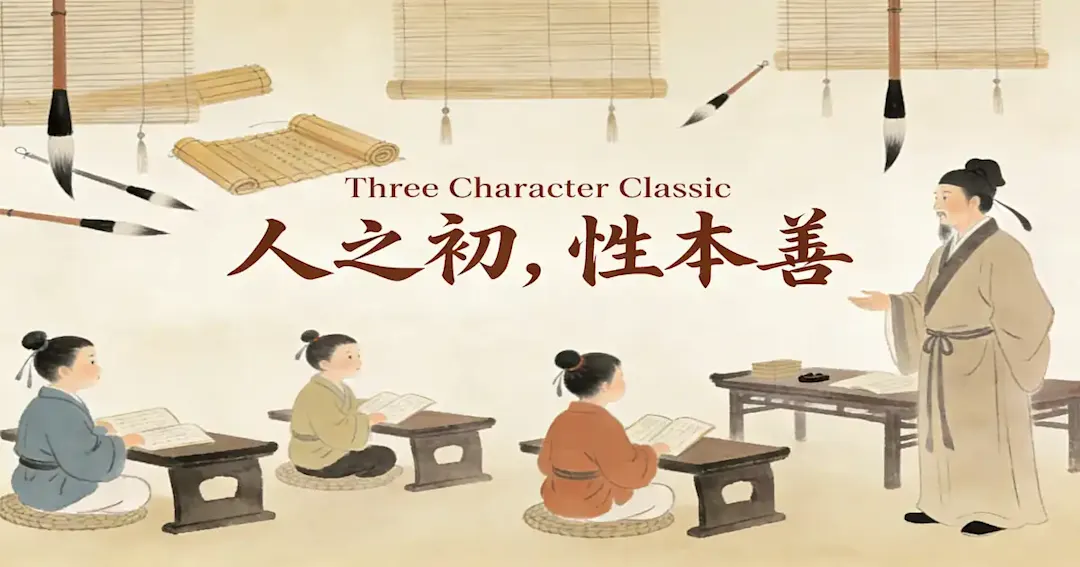
The three character classic—often called San Zi Jing—is a classic Chinese primer written in short, three-character phrases that are easy to chant and remember. Historically it was used as a child’s first step into literacy and classical culture.
What it is
Think of it as: a compact “starter library.” It contains lines about learning habits, values, family relationships, and then a quick tour through classic books and historical references.
What it is NOT
It’s not a modern conversational textbook.
It’s not all-or-nothing.
It’s not a replacement for real reading practice (it can support it).
Why it still works in 2026
Because it’s built for memory. And memory, used well, is a powerful learning tool. Cognitive science calls this “retrieval practice”: pulling something out of memory strengthens it and helps learning stick.
One small caveat: memorization helps most when it’s paired with meaning. That’s where parents can get stuck—especially if you didn’t grow up with the text yourself. We’ll fix that.
What’s inside three character classic: a simple map you can explain
The three character classic can feel like a random chant until you see its internal logic.Most kids don’t resist the words. They resist the confusion.
Part 1: “How kids learn” lines
These are the lines that talk about habits, focus, and why learning matters. They’re usually the easiest to connect to modern life.
Part 2: “How people treat each other” lines
Family, respect, kindness, self-control. The tone can feel formal, but you can translate it into normal family language (“say it kindly,” “listen first,” “help your sibling”).
Part 3: “Culture tour” lines
Classic books, history, famous people. This is where many families drop off—and that’s okay. You can cherry-pick.
If you would like to learn more about the “Three Character Classic”, you can check out our other Chinese blog post.

Key passages to learn:pinyin, modern meaning
Below are teachable lines from the three character classic that parents can actually use in daily life. Below are 20 “high-use” lines. They’re short, memorable, and teachable. I’m using pinyin so any parent can read it, even without Chinese characters on hand.
Group A: Learning habits
Original Text + Pinyin | Brief modern meaning | Transferable expressions |
人之初,性本善(Rén zhī chū, xìng běn shàn) | People start with a good nature / good potential. | “I can try again.” “Let’s reset.” “You’re a good kid—today was hard.” |
性相近,习相远(Xìng xiāng jìn, xí xiāng yuǎn) | Habits create the real differences over time. | “Good habits help.” “Small habits, big results.” “Let’s build a routine.” |
苟不教,性乃迁(Gǒu bù jiào, xìng nǎi qiān) | Without guidance, habits can drift. | “Let’s set a simple rule.” “We’ll do it step by step.” “I’ll show you how.” |
教之道,贵以专(Jiào zhī dào, guì yǐ zhuān) | Learning works best with focus. | “One thing at a time.” “Let’s focus on just this.” “Finish the small part first.” |
玉不琢,不成器(Yù bù zhuó, bù chéng qì) | Skill is shaped through practice. | “Practice makes it smoother.” “We’re polishing the skill.” “Let’s train it a little.” |
人不学,不知义(Rén bù xué, bù zhī yì) | Without learning, you won’t understand the ‘why.’ | “Learning helps it make sense.” “That’s why we learn.” “Let’s understand it, not just do it.” |
朝于斯,夕于斯(Zhāo yú sī, xī yú sī) | Do a little consistently—morning and night. | “A little every day.” “Short and steady.” “Two minutes is still progress.” |
As you practice these three character classic lines, you’ll notice a common pattern: learning the line is doable, but using it smoothly is harder. Pronunciation can drift, meaning can stay fuzzy, and it’s easy to get stuck at “repeat” instead of “use.”If you want a clearer next step, a Free LingoAce Trial Class can help. A teacher will do a quick level check and show how to turn three character classic lines into age-appropriate speaking prompts and reading practice.

Group B: Character and the Art of Living
Original Text + Pinyin | Brief modern meaning (EN) | Transferable expressions (EN) |
养不教,父之过;教不严,师之惰(Yǎng bù jiào, fù zhī guò; Jiào bù yán, shī zhī duò) | Guidance matters; standards and teaching effort matter too. | “We need a clear expectation.” “Let’s be consistent.” “We’ll practice it properly.” |
为人子,方少时;亲师友,习礼仪(Wéi rén zǐ, fāng shào shí; Qīn shī yǒu, xí lǐ yí) | When young, learn from teachers/friends and practice manners. | “Use polite words.” “Listen first.” “Try a respectful tone.” |
首孝悌,次见闻(Shǒu xiào tì, cì jiàn wén) | Build character basics first, then expand knowledge. | “Basics first.” “Let’s get the foundation right.” “Then we explore more.” |
勤有功,戏无益(Qín yǒu gōng, xì wú yì) | Diligence brings results; aimless play doesn’t help growth. | “Effort pays off.” “Let’s do the hard part first.” “We can play after we finish.” |
戒之哉,宜勉力(Jiè zhī zāi, yí miǎn lì) | Remind yourself; keep pushing with effort. | “Stay on it.” “Just a bit more.” “Don’t quit now.” “Keep going.” |
Group C: Family and relationships
Original Text + Pinyin | Brief modern meaning (EN) | Transferable expressions (EN) |
父子恩,夫妇从(Fù zǐ ēn, fū fù cóng) | Family relationships work best with care, support, and cooperation. | “We’re on the same team.” “Let’s help each other.” “Let’s do it together.” “Thanks for your help.” |
兄则友,弟则恭(Xiōng zé yǒu, dì zé gōng) | Older siblings should be kind; younger siblings should be respectful. | “Be gentle with your sibling.” “Use a respectful tone.” “Let’s take turns.” “Say it kindly.” |
长幼序(Zhǎng yòu xù) | Show proper courtesy and turn-taking between older and younger people. | “You go first.” “Let’s wait our turn.” “After you.” “Let’s line up.” |
友与朋(Yǒu yǔ péng) | Friendship should be built on kindness, trust, and mutual respect. | “Let’s be friendly.” “That wasn’t kind.” “Let’s play together.” “Use kind words.” |
此十义,人所同(Cǐ shí yì, rén suǒ tóng) | These basic virtues are widely accepted as common human values. | “These are our rules.” “We all agree on this.” “Let’s follow the same rule.” “That’s a good value to keep.” |

FAQ
These are the questions that keep coming up when families try the three character classic at home.
1) What is the three character classic and what is it used for?
San Zi Jing is a short, rhythmic classic Chinese primer used historically to introduce children to basic values, learning habits, and cultural references.In modern homes, it works best as a short daily language ritual, not a standalone curriculum.
2) Is three character classic good for kids who don’t speak Chinese at home?
Yes—if you use pinyin, audio, and very small goals. Start with one line per week and attach it to real-life moments. If your child needs more speaking structure, consider pairing it with an online Chinese class.
3) Where can I find the three character classic with pinyin and English translation?
Several reputable sites provide the text and pinyin-friendly versions. Pick one version and stick with it, so your child isn’t bouncing between slightly different lines.
4) Should my child memorize three character classic or focus on meaning?
Do both, but in this order: sound first, then meaning, then use. Retrieval practice works best when your child can recall and also connect the line to a simple idea.
5) How do I teach three character classic at home if I’m not fluent?
Use audio for modeling, keep sessions under ten minutes, and rely on the “one line → one use” rule. If pronunciation feedback is the sticking point, consider adding a live class or tutor so your child hears a consistent model each week.
Conclusion
The best version of this project is not “my kid can recite a lot.” It’s: my kid can remember a few lines, understands what they’re pointing at, and can use that idea in real life.
If you want a faster, clearer path from reciting to speaking and reading—especially when you’re not fluent yourself—book a free LingoAce trial class and use the leveling assessment to build a plan that fits your child’s age and starting point.