If you grew up with Qingming, you probably remember the feeling more than the details: the quiet car ride, the smell of incense, someone reminding you to stand still, and then—almost surprisingly—a snack or a walk outside afterward. If you didn’t grow up with it, Tomb Sweeping Day can sound intimidating, especially once you add kids into the mix.
In 2026, many families are navigating a familiar problem: we want our kids to know where they come from, but we also want the day to feel respectful, age-appropriate, and doable on a regular weekend schedule. The good news is that Tomb Sweeping Day is flexible. It has core meaning (remembering loved ones and honoring ancestors), and it also has room for modern, at-home, and kid-friendly ways to participate—especially when you live far from family graves.
Tomb Sweeping Day 2026 Date (and why it changes slightly)
For most places that observe the holiday, Tomb Sweeping Day 2026 falls on Sunday, April 5, 2026. Depending on where your extended family is based, the public holiday can shift by region. For example, some areas observe an additional day off on the following Monday.
Why does the date feel like it “moves”?
Qingming is tied to the traditional solar-term calendar, landing about the 15th day after the spring equinox—so it’s typically in early April.
That means most years it’s around April 4–6, but it can differ by location and holiday policy.
A simple family planning tip: If April 5 doesn’t work for your family schedule, it’s still meaningful to observe Tomb Sweeping Day on a nearby weekend. The heart of the day is remembrance and respect—your calendar doesn’t have to be perfect for the practice to count.
If you only have 30 minutes: Pick one small action:
tidy a photo area at home,
place flowers or a small food offering,
share one short story about a loved one,
say one simple phrase together (you’ll find options below). You’ll be surprised how much “heritage” fits into half an hour.
What Tomb Sweeping Day Means (Qingming in plain language)
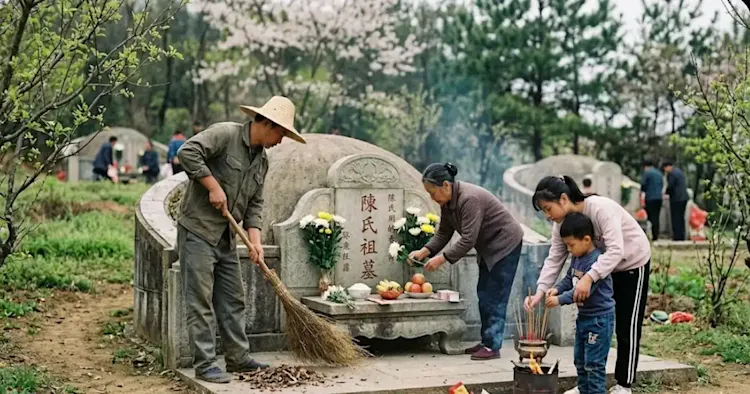
At its core, Tomb Sweeping Day is a day for honoring ancestors and remembering loved ones who have passed away. Traditionally, families clean gravesites and leave offerings as a sign of respect.
But Qingming is not only about sadness. Many descriptions of the holiday highlight a bittersweet balance: remembrance paired with a “spring outing”—being outdoors, taking a walk, sometimes even sharing a picnic. This blend matters for kids: it helps them understand that remembering someone doesn’t have to feel scary. It can be calm, warm, and even quietly hopeful.
A parent-friendly way to explain Tomb Sweeping Day to kids
You don’t need a perfect script. You just need something true, short, and age-appropriate.
Ages 3–6 (keep it gentle and concrete): “Today is Tomb Sweeping Day. We’re going to remember our family members who aren’t here anymore. We clean, we bring flowers, and we say ‘thank you’ for the love they gave our family.”
Ages 7–10 (add meaning + choice): “Tomb Sweeping Day is when we show respect to our ancestors. It’s like taking care of family history. We’ll do something small to remember them—maybe clean a place, bring flowers, or tell a story.”
Ages 11–15 (invite conversation): “Tomb Sweeping Day is about memory and family roots. Different families do it differently. I want you to know the traditions, but I also want us to choose a way that feels respectful and real for our family.”
If your child asks, “Is this like Halloween?” you can say: “Not really. Tomb Sweeping Day is about family and respect, not scary stuff.”
Tomb Sweeping Day Traditions (what families typically do)
Most families follow the same general pattern: cleaning, offering, remembering, and leaving.
1) Gravesite steps (a simple, respectful checklist)
If your family visits a cemetery or ancestral tomb, here’s a clear, low-stress sequence:
Tidy the area Sweep leaves, wipe the headstone, remove weeds (if allowed). The cleaning is symbolic: it’s care and respect.
Arrange offerings Offerings vary by family. Common categories include flowers, food, tea, or symbolic paper items.
Light incense (if your family does this) Incense is often described as part of honoring the deceased. If you’re in a cemetery that forbids flames, skip it. Respecting rules is part of respect.
Quiet moment + words Some families bow. Some say a short message (out loud or silently). With kids, a 10-second pause is plenty.
Close the visit Before leaving, many families take a final look, tidy anything left behind, and exit calmly.
Parent note: If you’re worried your child will be “bored,” give them a job:
carry flowers,
wipe the stone gently,
hold a small item,
or choose one photo to bring.
A child who has a role is less likely to fidget—and more likely to remember.
2) What offerings mean (so it doesn’t feel random)
Offerings on Tomb Sweeping Day aren’t meant to be a shopping list. They’re symbols.
Flowers: respect, remembrance, love.
Food or tea: care and hospitality—like “we’re visiting family.”
Incense: a ritual marker; for many families it’s a traditional expression of honoring the deceased.
Paper offerings: in some traditions, paper items represent providing for ancestors. (Not every family does this, and many diaspora families choose simpler approaches.)
A modern approach that still feels respectful: If you prefer not to burn anything (environmental concerns, local rules, personal preference), choose one meaningful substitute:
fresh flowers,
a handwritten note,
or a small donation or act of service in someone’s memory (more on that below).
3) The “spring outing” side of Tomb Sweeping Day
A detail many parents appreciate: Qingming is tied to early April and the “clear and bright” season. That’s why some families connect the day with a walk in nature or a picnic. It’s not disrespectful—it’s part of the cultural rhythm: remembrance, then life continuing.
If you want kids to accept Tomb Sweeping Day as “a family day” rather than “a sad day,” the outing helps.
Tomb Sweeping Day Etiquette and common taboos (what to do, what to avoid)
Etiquette varies by region and family, so the safest rule is: follow the elders you’re with, keep your tone calm, and avoid turning the visit into a photoshoot.
Here are a few practical, parent-relevant guidelines:
What to do
Dress simply (you don’t need formal black, but avoid anything that feels like party attire).
Keep voices low and explain expectations to kids before you arrive.
Let kids participate briefly: a flower, a bow, a quiet moment. That’s enough.
What to avoid (especially with kids around)
Don’t force big emotions. Kids may feel nothing. That’s normal.
Don’t use “Happy Tomb Sweeping Day!” Some families do exchange greetings, but many prefer neutral language like “We’re remembering our ancestors today.” (If you want holiday greetings, keep them respectful and low-key.)
Avoid loud play right at the gravesite. If your child needs to move, step aside and let them walk with you for a minute.
If you can’t visit a grave this year: That’s common for families. Many guides note modern alternatives and at-home remembrance options that still honor the spirit of Qingming.

Tomb Sweeping Day for kids (how to include them without making it scary)
Here’s the reality: most kids don’t connect to “ancestor respect” as an abstract concept. They connect to stories, objects, and rituals they can do with their hands.
4 kid-friendly activities (easy, meaningful, and not dramatic)
1) The “one object, one story” memory box
Pick one small item connected to a loved one (a recipe card, a scarf, an old photo). Tell one story that answers: “What did we learn from them?”
Kid-friendly prompt: “What’s one thing Grandpa was really good at?” This keeps the mood warm and concrete.
2) Family photo cleaning + mini-story
Wipe a framed photo together and share a 30-second story. It’s basically “tomb sweeping” at home: care + remembrance.
3) A short letter (older kids)
Older kids can write:
“One thing I wish you could see about my life is…”
“One thing I want to remember about you is…”
If your teen is reluctant, let them write in English. Cultural connection counts even when language doesn’t cooperate.
4) A walk outside with one family question
During a walk, ask:
“Who do you think you’re most like in our family?”
“What’s one family tradition you want to keep when you’re older?”
This ties the Qingming “spring outing” vibe to real family conversation.
The parent checkpoint (learning motivation moment #1)
If your child can explain this holiday in English but freezes in Chinese—or can’t name basic family words—it’s usually not laziness. It’s missing language tools. Culture becomes much more “sticky” when kids can say even a few real phrases.
Later in this guide, I’ll give you simple Chinese vocabulary for Tomb Sweeping Day—and a short practice routine that doesn’t feel like homework.
Ways to remember loved ones when you live far away
For many families, the hardest part of Tomb Sweeping Day is logistics: the grave is in another country, your relatives are in different cities, and you’re trying to keep the day meaningful without turning it into a stressful production.
Modern resources increasingly describe options like keepsakes, memorial items, and alternative remembrance practices for families who can’t visit in person.
Here are practical, respectful ideas that work well at home:
1) A “memory corner” (5 minutes to set up)
Choose a small table or shelf. Add:
a photo,
flowers,
a cup of tea,
and one meaningful object.
Then do a tiny ritual:
tidy the area,
stand quietly for 10 seconds,
share one sentence each: “One thing I remember is…”
2) A family voice note (great for long-distance relatives)
Send a voice note to grandparents or relatives:
“We’re observing Tomb Sweeping Day today. Can you tell us one story about ___?” Kids love hearing real voices, and it turns tradition into a living family connection.
3) Cook one food that carries memory
Food doesn’t have to be ceremonial. It can be personal:
“This was Great-Grandma’s comfort food.”
“This is what we ate after visiting the cemetery.”
4) Plant something (a living remembrance)
A small plant, a tree, or even herbs on a windowsill can become your yearly “we remember and we grow” ritual. It also fits the early-April renewal theme often connected to Qingming.
5) An act of service in someone’s honor
Donate books, volunteer, or help a neighbor—then say, “We’re doing this in memory of ___.” If your kids are sensitive to grief, this is a powerful option: it shifts the focus from “loss” to “love expressed through action.”
The parent checkpoint (learning motivation moment #2)
When families do remembrance at home, kids often ask follow-up questions later (at bedtime, in the car, randomly). That’s the moment language matters. If your child doesn’t have the words for family relationships, feelings, or respect, they’ll stop asking—or they’ll only ask in English and keep “Chinese culture” in a separate mental box.
You don’t need perfect bilingual kids. You just want them to have enough language to stay curious.
Tomb Sweeping Day vocabulary and phrases (Simple Chinese + kid-usable)
Even if your family speaks mostly English at home, a few phrases can turn Tomb Sweeping Day into something kids can participate in, not just observe.
Key words (plain meanings)
清明节 (Qīngmíng jié) — Qingming Festival / Tomb Sweeping Day
扫墓 (Sǎomù) — to sweep/clean a grave
祭祖 (Jìzǔ) — to honor ancestors
祖先 (Zǔxiān) — ancestors
纪念 (Jìniàn) — to remember/commemorate
花 (Huā) — flowers
香 (Xiāng) — incense
供品 (Gòngpǐn) — offerings
Short phrases kids can actually say
(You can pick 2–3. That’s enough.)
今天是清明节。 Jīntiān shì Qīngmíng jié. “Today is Tomb Sweeping Day.”
我们来纪念家人。 Wǒmen lái jìniàn jiārén. “We’re here to remember our family.”
我想你。 Wǒ xiǎng nǐ. “I miss you.”
谢谢你照顾我们。 Xièxie nǐ zhàogù wǒmen. “Thank you for taking care of us.”
这是给你的花。 Zhè shì gěi nǐ de huā. “These flowers are for you.”
A 5-minute practice routine (no worksheets)
Day 1: say “Today is Qingming” once at breakfast
Day 2: add one family word (grandma/grandpa/ancestor)
Day 3: practice “I miss you”
Day 4: practice one thank-you sentence
Day 5: child chooses one phrase to say during your ritual
If your child understands the story of Tomb Sweeping Day but can’t comfortably say even a couple of sentences—this is exactly the kind of “real-life language” that a structured speaking class helps with. Many parents choose programs like LingoAce because lessons are built around practical topics (family, traditions, daily life) and taught in a way kids will actually respond to; on Trustpilot, parents often mention engaging teachers and interactive lessons that help their child stay interested.
If you want, you can book a LingoAce trial class and ask the teacher to use Qingming as a conversation theme, so your child practices language through something your family already does.

The parent checkpoint (learning motivation moment #3)
A lot of kids can repeat a phrase once—but they can’t use it in context under pressure (“Say it to Grandma!”). That’s normal. Confidence comes from guided practice and repetition across real situations: family visits, holidays, phone calls, and stories.
“Do we need to do Tomb Sweeping Day the traditional way?” (a gentle decision guide)
Families often feel torn:
One parent wants tradition exactly right.
The other wants something simple that won’t overwhelm the kids.
Kids just want to know what’s happening and why.
Here’s a grounded way to decide.
Option A: Traditional gravesite visit (best when you have access + family agreement)
Choose this if:
the gravesite is accessible,
your family expects the visit,
and your child can handle a calm, quiet setting.
Option B: At-home remembrance (best for distance, time, or sensitive kids)
Choose this if:
you live far away,
the family grave is overseas,
or your child is in a “big feelings” phase.
It’s still Tomb Sweeping Day when you do it at home, because the purpose—honoring and remembering—is still there.
Option C: “Modern + meaningful” (best when you want tradition + personal values)
Choose:
flowers instead of burning,
a donation,
planting something,
or a family story night.
The point is not to perform a ritual perfectly. It’s to pass down the habit of remembering.
The parent checkpoint (learning motivation moment #4)
If your child is growing up in English-majority school settings, culture can start to feel like “something we do sometimes” instead of “something I belong to.” A small, repeated holiday practice—plus enough language to talk about it—helps keep identity from fading into the background.
This is also why families often look for structured support (grandparents aren’t always available, and parents are busy). A consistent learning plan can make “we’ll teach Chinese at home” feel realistic again.
FAQ
1) When is Tomb Sweeping Day 2026? For many regions, Tomb Sweeping Day 2026 is on Sunday, April 5, 2026.
2) Is Tomb Sweeping Day the same as Qingming Festival? Yes—Tomb Sweeping Day is a common English name for Qingming Festival (清明节). The festival is associated with honoring ancestors and often includes tomb sweeping, offerings, and a spring outing.
Many families clean gravesites, leave offerings, burn incense (where permitted), and take a quiet moment to remember ancestors. Some families also include a walk in nature or a picnic during the day.
4) What if we can’t visit a grave in 2026? That’s common, especially for diaspora families. You can observe Tomb Sweeping Day at home with a memory corner, flowers, storytelling, a letter, planting something, or an act of service in someone’s honor.
5) How can I explain Tomb Sweeping Day to my child without making it scary? Keep it simple: “We’re remembering family and saying thank you.” Let kids participate with one small action (flowers, wiping a photo, or saying one short phrase). Pair it with a calm activity afterward so the day feels safe and steady.
Conclusion
Tomb Sweeping Day 2026 doesn’t have to be complicated to be meaningful. Whether you visit a gravesite, create a small ritual at home, or honor loved ones through stories and acts of care, the heart of the day is the same: remembering, respecting, and staying connected to family roots.
If you want your child to do more than “go along with it”—if you want them to understand it and talk about it—a few simple phrases and a short practice routine can make a huge difference. And if your family would benefit from structured support, you can try a LingoAce trial class and ask for a lesson theme around family traditions like Tomb Sweeping Day, so your child builds real-life speaking confidence through culture they’re already living.