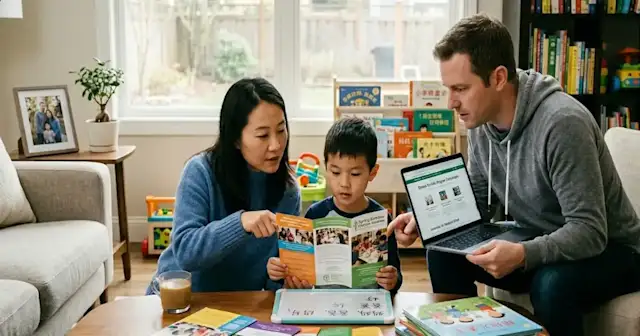

If you’re googling for the best chinese self study book for your child, you’re probably not looking for “the perfect book.” You’re looking for the book that gets opened—on a random Tuesday, after dinner, when everyone’s a bit tired.
Books are like tiny “home tutors” that don’t argue back. Still, most families discover the same thing: a book can start the habit, but it can’t fix pronunciation, keep momentum, or tailor the pace when your child zigzags. That’s where a real teacher (and a clear plan) starts to matter—more on that at the end.
Quick-start: pick one lane, not a whole library
If your child is 3–6: start with pinyin-friendly picture books and repeatable topics (family, feelings, bedtime).
If your child is 6–9: add leveled readers (short, predictable patterns).
If your child is 9–12: bring in graded readers and simple nonfiction.
If your child is 12–15: consider a structured textbook + a reader (one for accuracy, one for fun).
“Give me the top 10 now”
Here are 10 high-confidence “start here” picks (then the full 60-table follows):
Picture books with pinyin and everyday topics (habits, emotions)
Picture books with pinyin guides for non-fluent parents
Mandarin Companion graded readers (Breakthrough / Level 1)
Sinolingua Rainbow Bridge graded readers (gentle ramp-up)
Chinese Breeze graded readers (good stepping stone)
A “characters practice” workbook (short daily handwriting, not marathon drills)
A bilingual holiday/culture picture-book set (easy “repeat every year” motivation)
A beginner-friendly textbook track like Integrated Chinese (older kids)
A “read-aloud” routine + a dictionary tool like Pleco for quick lookups
One weekly live class to stop bad habits early (yep, this is the part parents wish they did sooner)
How to choose the best chinese self study book for kids (without overthinking it)
A useful best chinese self study book for children usually gets three things right:
Friction is low. Big font, clean layout, short chunks, audio support if possible.
Repetition feels “normal,” not boring. Kids don’t mind rereading… if the content is familiar and a little funny.
It matches your home reality. If you’re not fluent, you need pinyin support (or a separate parent guide), otherwise you’ll avoid reading time. That’s just honest.
Two nerdy-but-helpful notes:
If you’re using pinyin, stick to standard pinyin conventions (it keeps your child compatible with most learning materials and references). The Library of Congress notes that pinyin is the basis for its romanization guidelines, which gives you a sense of how standardized it is.
If you care about measurable levels later, it helps to know tests like HSK exist (even if you never plan to take one). The official HSK site describes it as a standardized proficiency test run by CTI.

Best chinese self study book picks (60 total) — table you can scan
How to use this table like a normal busy parent:
Choose 2 picks: one “reading for fun” + one “skills builder.”
Do 15 minutes a day for two weeks.
If the book doesn’t get opened, it’s not “bad.” It’s just not your child’s book. Swap. No guilt.Note: Some “picks” are series/collections (because that’s how most families actually buy and rotate books at home).
Pick (Book/Series/Format) | Best for (Age/Level) | Why it works at home | Parent tip | |
Ages 0–3 (Board books & routine language) | ||||
1 | Sturdy board books: family words (妈妈/爸爸/宝宝 themes) | 0–3 | High repetition, low effort | Point + say one word, don’t translate everything |
2 | Board books: animals & sounds | 0–3 | Kids already love animal noise games | Let your child “teach” you the sounds |
3 | Touch-and-feel bilingual board books | 0–3 | Sensory hook keeps attention | One page per night is plenty |
4 | Lift-the-flap Chinese/English board books | 0–3 | Built-in “game” mechanic | Ask “Where is…?” then reveal |
5 | “Daily routine” board books (bath/bedtime) | 0–3 | Fits real life | Use the same 5 phrases nightly |
6 | Nursery rhyme books with pinyin (parent-facing) | 0–3 | Rhythm makes recall easier | Don’t chase perfect tones yet |
7 | Photo-word books (real objects) | 0–3 | Concrete beats abstract | Use your own photos if possible |
8 | “First 100 words” style Chinese vocab books | 0–3 | Quick wins, quick review | Keep it in the car/diaper bag |
9 | Bedtime story board books (very short) | 0–3 | Routine = consistency | Stop mid-story if child loses interest |
10 | “Feelings” board books (happy/sad/mad) | 0–3 | Useful language, daily use | Model one feeling word per day |
Ages 3–6 (Picture books with pinyin + parent support) | ||||
11 | Picture books with pinyin + English support lists | 3–6 | Parents can actually read along | Read first in English, then try Chinese |
12 | Lotus Leaf Books “books with pinyin + parent guides” collections | 3–7 | Designed for non-fluent parents | Use the vocab guide like a script |
13 | Chalk Academy’s pinyin/English picture-book recommendations | 3–8 | Curated by real parent needs | Pick 3 books and rotate weekly |
14 | Habbi Habbi topic books (family, habits, emotions) | 3–6 | High-yield daily vocab | Repeat the same page for 3 days |
15 | “Mina Learns Chinese” style bilingual kids series | 3–7 | Relatable scenes (school/friends) | Let child choose which page to reread |
16 | Picture books about food + “I like/I don’t like” patterns | 3–6 | Easy conversation starter | Use it at the dinner table |
17 | Picture books about body parts + action verbs | 3–6 | You can act it out | Turn it into Simon Says |
18 | Classic folktales in simplified Chinese (short versions) | 4–7 | Story motivation | Don’t explain every detail—keep flow |
19 | Holiday/culture picture books (Mid-Autumn, Lunar New Year) | 4–8 | Seasonal excitement boosts rereads | Save for the season; it feels special |
20 | “Question & answer” picture books (Where? Who? What?) | 3–6 | Built-in speaking prompts | Ask the question in Chinese only |
Ages 6–9 (Leveled readers & early character confidence) | ||||
21 | Leveled readers: very short sentences, repeated patterns | 6–8 | Predictability builds fluency | Read the same level for a week |
22 | Leveled readers with audio (QR/app/pen) | 6–9 | Kids can replay independently | Audio first, then read together |
23 | Short nonfiction readers (animals, space) | 6–9 | Curiosity wins | Let child pick the topic |
24 | School-life readers (classroom, friends) | 6–9 | Practical vocab | Role-play one dialogue |
25 | Simple comics / picture-comics | 7–9 | Visual context helps guessing | Cover one speech bubble, predict it |
26 | Character “radicals for kids” books (gentle intro) | 7–9 | Makes characters less scary | Learn 2 radicals a week |
27 | Character tracing workbook (5–10 min pages) | 6–9 | Tiny daily practice sticks | One line only; stop before tears |
28 | Sentence-building workbooks (fill-in blanks) | 7–9 | Turns reading into output | Keep answers silly on purpose |
29 | Pinyin-to-character transition readers | 6–9 | Smooth bridge | Reduce pinyin exposure gradually |
30 | Bilingual chapter-book “starter” readers (very short chapters) | 8–9 | Builds stamina | Celebrate finishing a chapter |
Ages 9–12 (Graded readers + vocabulary growth) | ||||
31 | Mandarin Companion Breakthrough series | 8–12 | Controlled characters, story-driven | Read aloud together, then silent reread |
32 | Mandarin Companion Level 1 series | 9–12 | Longer plots, still manageable | Keep a “new words I like” list |
33 | Sinolingua Rainbow Bridge graded readers | 9–12 | Popular stepping-stone option | Choose stories tied to your child’s hobbies |
34 | Chinese Breeze graded readers | 9–12 | Helps build reading volume | Don’t translate; summarize in English after |
35 | Mystery/detective graded stories | 9–12 | Page-turner effect | Ask “Who do you think did it?” in Chinese |
36 | Mythology/legends graded stories | 9–12 | Cultural hook | Pair with a quick YouTube clip (then reread) |
37 | Dialogue-heavy readers | 9–12 | Supports speaking | Act it out like a mini-play |
38 | “Idioms for kids” storybooks (very simple) | 9–12 | Memorable chunks | One idiom a week is enough |
39 | Writing prompts workbook (short paragraphs) | 10–12 | Builds output | Use 3-sentence limit at first |
40 | Test-prep light readers (not full exam mode) | 10–12 | Adds structure | Keep it casual; avoid pressure |
Ages 12–15 (Structured textbooks + real progress) | ||||
41 | Integrated Chinese (structured textbook track) | 12–15 | Clear progression + dialogues | Do the audio every time, even if rushed |
42 | Integrated Chinese workbook companions | 12–15 | Reinforces patterns | Short sessions beat “catch-up weekends” |
43 | “Grammar for learners” practice books | 12–15 | Fixes common errors | One pattern per week, then use it in speech |
44 | Writing practice books (guided essays) | 12–15 | Supports school needs | Use templates, then slowly remove them |
45 | Character frequency-based vocabulary books | 12–15 | Efficient learning | Focus on high-frequency characters |
46 | HSK-aligned textbooks (only if you need HSK) | 12–15 | Goal clarity | Don’t overstudy lists; read more |
47 | Listening-based textbooks with scripts | 12–15 | Listening is usually the gap | Shadow 2 minutes a day |
48 | “News for learners” readers (simplified) | 12–15 | Real-world relevance | Pick one topic (sports, tech) |
49 | Bilingual teen fiction (light, modern) | 12–15 | Motivation | Allow some English—momentum matters |
50 | Debate/speaking practice books (guided) | 12–15 | Great for confident speakers | Record 30 seconds, replay, improve |
Any age (family-friendly bonus picks that reduce resistance) | ||||
51 | Read-aloud storybooks with predictable refrains | 3–10 | Kids join in naturally | Pause and let them “fill the blank” |
52 | Joke books / silly riddle books (simple Chinese) | 7–12 | Humor = repetition | Let the child tell the joke to someone |
53 | Sticker activity books (Chinese prompts) | 3–8 | Hands keep brains engaged | Use for travel or waiting rooms |
54 | Maze/puzzle books with Chinese instructions | 6–10 | Low-pressure reading | Celebrate finishing, not accuracy |
55 | Cooking/food kids books with simple steps | 6–12 | “Do the thing” language | Cook one recipe, repeat phrases |
56 | Nature/science mini-readers | 7–12 | Topic interest drives volume | Connect to a museum trip |
57 | Calligraphy starter books (gentle) | 8–15 | Makes writing “cool” | Keep sessions short; quality over quantity |
58 | Parent pronunciation helper + pinyin reference | Parents | Keeps you consistent | Learn 5 sounds; don’t learn “everything” |
59 | A dictionary tool to support reading time (Pleco) | 8–15 | Quick lookup prevents frustration | Use it sparingly—avoid word-by-word reading |
60 | A simple proficiency reference (ACTFL-style “can-do” thinking) | Parents | Helps you set realistic expectations | Track what your child can do , not just vocab |

Best chinese self study book routine (15 minutes a day) that doesn’t wreck your evening
This is the part people skip… and then wonder why the shelf looks untouched.
3 minutes: re-read one super-easy page (confidence first)
7 minutes: new reading (you read, child points; then swap)
3 minutes: “say it your way” (child changes one word)
2 minutes: choose tomorrow’s book (tiny commitment)
If you want a low-drama tracking idea: use a sticky note with 10 boxes. Check one box per day. When it’s full, your child picks a small reward. Not a huge thing. Just something that says “I noticed you tried.”
Best chinese self study book mistakes I see parents make (and yes, I’ve done a couple)
Buying too advanced “so they can grow into it.” They usually don’t grow into it. They avoid it.
Correcting every tone mid-story. Storytime becomes a test. Kids feel it immediately.
Doing only worksheets. Worksheets have a place. But reading creates the volume you need for real progress.
Assuming pinyin = “bad.” Pinyin is a bridge. The problem is living on the bridge forever.
FAQ (parents actually ask these)
Is pinyin okay, or will it delay characters? Pinyin is fine as a starter, especially for younger kids and non-fluent parents. It’s also a standardized system used widely in reference contexts.
Do we need HSK books for kids? Only if you have a clear reason (a school requirement, a test goal). HSK is a standardized proficiency test, but many families do better focusing on daily reading + speaking first.
My child can “understand” but won’t speak. Which best chinese self study book helps? Choose dialogue-heavy readers and act them out. Pair it with a short speaking routine (even 2 minutes) so the book doesn’t stay passive.
Integrated Chinese sounds popular—should I use it for my child? It’s often recommended as a structured path and can work especially for middle school and up. But it can feel “school-ish,” so pairing it with an enjoyable reader helps.
What tool helps when we’re stuck on a word mid-story? A quick dictionary app can reduce friction (Pleco is widely used for mobile Chinese reference and learning). Just don’t turn reading into nonstop tapping.
Wrap-up (and the honest next step)
This list should help you find a best chinese self study book that your child will actually use at home—because you’re picking by fit, not by hype.If you want one shortcut: start with one fun reader + one structured skill book, keep it to 15 minutes a day, and protect the “light” feeling around Chinese.
And when you’re ready to stop guessing pronunciation, pacing, and what to do next week: book a free LingoAce trial class. A good teacher can take the same books you already own and turn them into a real routine your child can follow—without you having to become the full-time coach.