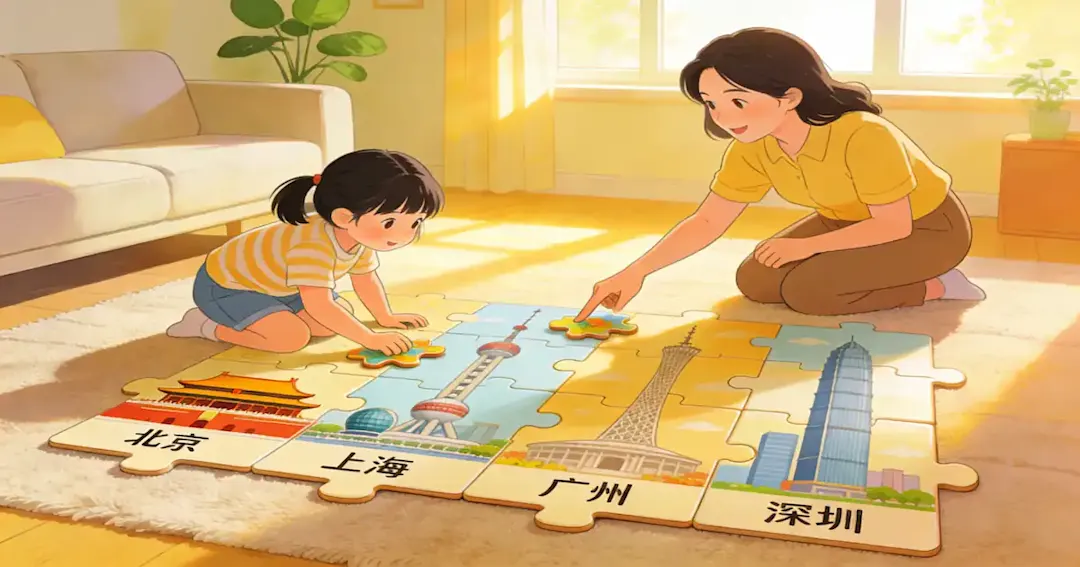

If you’re here for chinese city names, you probably have a very normal parent problem: a school project due tomorrow, a map worksheet, a kid who suddenly asks “How do you say Shanghai?” right when you’re making dinner… and you don’t want to spend 40 minutes hunting for the _one_ list that’s actually readable.
Chinese city names you’ll see everywhere
These are the “common on maps / books / worksheets” set. If your child learns only one table from this post, make it this one.
City (English) | 中文 | Pinyin | Quick meaning | One easy sentence kids can use |
Beijing | Běijīng | North capital | Běijīng shì Zhōngguó de shǒudū. (Beijing is China’s capital.) | |
Shanghai | 上海 | Shànghǎi | On the sea | Shànghǎi hěn xiàndài. (Shanghai feels modern.) |
Guangzhou | 广州 | Guǎngzhōu | Broad prefecture | Guǎngzhōu zài nánfāng. (Guangzhou is in the south.) |
Shenzhen | 深圳 | Shēnzhèn | Deep trench | Shēnzhèn lí Xiānggǎng hěn jìn. (Shenzhen is close to Hong Kong.) |
Chengdu | Chéngdū | Become capital | Chéngdū de cài yǒudiǎn là. (Chengdu food is a bit spicy.) | |
Hangzhou | 杭州 | Hángzhōu | Hang prefecture | Hángzhōu yǒu Xīhú. (Hangzhou has West Lake.) |
Xi’an | 西安 | Xī’ān | West peace | Wǒ xiǎng kàn bīngmǎyǒng zài Xī’ān. (I want to see the Terracotta Army in Xi’an.) |
Nanjing | 南京 | Nánjīng | South capital | Nánjīng yǒu hěn duō dàxué. (Nanjing has many universities.) |
Tianjin | 天津 | Tiānjīn | Heavenly ford | Tiānjīn lí Běijīng bù yuǎn. (Tianjin isn’t far from Beijing.) |
Chongqing | 重庆 | Chóngqìng | Double celebration | Chóngqìng yǒu hěn duō shānpō. (Chongqing has lots of hills.) |
Wuhan | 武汉 | Wǔhàn | (historical name) | Wǔhàn zài Zhōngguó zhōngjiān. (Wuhan is in central China.) |
Suzhou | 苏州 | Sūzhōu | Su prefecture | Sūzhōu yǒu hěn duō yuánlín. (Suzhou has many classical gardens.) |
Chongqing: kids often say “chong-king.” It’s closer to Chóng-qìng (two syllables, second one crisp).
Suzhou: the “zh” is not English “z.” If they can’t get it yet, don’t panic—consistency > perfection.

Chinese city names that teach patterns
Once kids spot patterns, memorization stops feeling like random trivia.
Mini legend (the “ohhh” cheat sheet):
东 / 西 / 南 / 北 = east / west / south / north
江 / 河 = river
山 = mountain
City (English) | 中文 | Pinyin | Pattern to notice | Quick meaning |
Jinan | 济南 | Jǐnán | 南 (south) | South of the Ji (river) |
Shenyang | 沈阳 | Shěnyáng | 阳 (sunny side) | “Sunny side” of the river area |
Luoyang | 洛阳 | Luòyáng | 阳 (sunny side) | “Sunny side” by the Luo (river) |
Changchun | 长春 | Chángchūn | 春 (spring) | Long spring |
Harbin | Hā’ěrbīn | sound-based | Name is more phonetic than “meaningful” | |
Qingdao | 青岛 | Qīngdǎo | 岛 (island) | Green/blue island |
Ningbo | 宁波 | Níngbō | 波 (waves) | Peaceful waves |
Kunming | 昆明 | Kūnmíng | 明 (bright) | Bright / clarity |
Huangshan (area) | 黄山 | Huángshān | 山 (mountain) | Yellow Mountain |
Not every place name is a neat “dictionary meaning.” Some are historical, some phonetic, some… honestly just old and stubborn. That’s normal. It also means you don’t need to “translate” every name perfectly to learn it.
2-minute home game: “Meaning Detective”
Point to a name with 北/南/东/西 and ask: “Which direction is this?”
Let the child guess in English first.
Then say the pinyin together once. Done. Two minutes is plenty.

Chinese city names kids remember faster
These are the ones that create a picture in a kid’s head, which helps retention. And yes, it’s totally fine if your child loves the meaning more than the geography at first.
City (English) | 中文 | Pinyin | Vivid meaning hook | A one-line “story” you can say |
Hong Kong | 香港 | Xiānggǎng | Fragrant harbor | “Imagine a harbor that smells like flowers.” |
Macao | 澳门 | Àomén | Bay gate | “A gate into the bay—like an entryway.” |
Dalian | 大连 | Dàlián | Great link | “A city that ‘connects’ things.” |
Xiamen | 厦门 | Xiàmén | Grand mansion gate | “A fancy gate you walk through.” |
Fuzhou | 福州 | Fúzhōu | Blessing prefecture | “A city named ‘good luck’—kids love that.” |
Changsha | Chángshā | Long sand | “Long sandy stretch—picture a beach.” | |
Shijiazhuang | 石家庄 | Shíjiāzhuāng | Stone family village | “A village of stone houses.” |
Hefei | 合肥 | Héféi | (historical) | “This one’s more history than literal meaning.” |
Guilin | 桂林 | Guìlín | Osmanthus forest | “A forest that smells sweet (osmanthus).” |
If your child is trying to say these out loud (not just copy them), a teacher correcting pinyin early makes a huge difference. If you want a structured way to practice city names + real conversation, you can book a trial class with LingoAce and let a teacher do the “wait, your tongue goes here” part for you.

How to practice chinese city names at home
You don’t need to be the pronunciation police. You just need a repeatable routine that doesn’t turn into a fight.
1) Do the “3-card flip”
Pick 3 rows from any table.
Write English on one side, 中文 + pinyin on the other.
Flip quickly: child says English → parent shows Chinese side → both say pinyin once.
It’s short enough that kids don’t dread it. That’s the whole point.
2) Use one reusable sentence frame
Pick one and reuse it all week:
Wǒ xiǎng qù _____. (I want to go to ____.)
_____ zài nǎlǐ? (Where is _____?)
Wǒ tīngshuō _____ hěn yǒumíng. (I heard _____ is famous.)
Kids don’t need 30 different sentences. They need one sentence they can win with.
3) Play “Map Tap, You Say”
Open any China map image (tablet, book, printout—whatever).
Parent taps a spot (or points).
Child chooses a city from the list and says it.
Switch roles.
This sneaks in geography without making it feel like “extra homework.”
FAQ
1) What are the most useful chinese city names for beginners in 2026?
Start with the cities that appear in kids’ books and worksheets the most: Beijing, Shanghai, Guangzhou, Shenzhen, Chengdu, Hangzhou, Xi’an, Nanjing. If your child can read/say those, they’re already ahead of most beginners learning chinese city names.
2) How do I write chinese city names in Chinese characters and pinyin without messing it up?
Copy from a clean table (like the ones above), and watch for two easy errors: missing tone marks and missing the apostrophe in Xi’an (Xī’ān). If your child is graded on spelling, consistency matters more than being “fancy” with rare formats. For chinese city names, “correct and readable” wins.
3) Why do some chinese city names have older spellings (like Beijing vs Peking)?
Older spellings often come from older romanization systems or historical usage in English. In school today, pinyin is the most common standard. If your child sees an older spelling, treat it like a nickname: “Same city, different spelling,” then keep using the pinyin-based form for homework.
4) What’s the easiest way for kids to remember chinese city names quickly?
Tie the name to a picture: direction words (north/south/east/west), nature words (mountain/river), or a silly mental image (“fragrant harbor”). Kids remember chinese city names better when the name _means something to them_, even if the meaning is simplified.
5) Are chinese city names the same thing as provinces?
No—provinces are larger regions; cities sit inside provinces (or sometimes have special administrative status). For a child’s project, it’s okay to say: “Province = like a state, city = inside it.” That simple distinction helps kids organize chinese city names without getting overwhelmed.
Conclusion
If your family only uses this once, you still get value:
You now have 30 city names in a clean, copy-ready format.
You can teach patterns (directions, mountains, rivers) instead of pure memorization.
You have three quick routines that fit into real life, not an imaginary perfect schedule.
And if your child is ready to go from “I can list city names” to “I can say them confidently in a sentence,” a guided speaking routine helps—especially for pinyin and tones. If you’d like, book a LingoAce trial class and let a teacher build a simple weekly plan around your child’s level and interests.