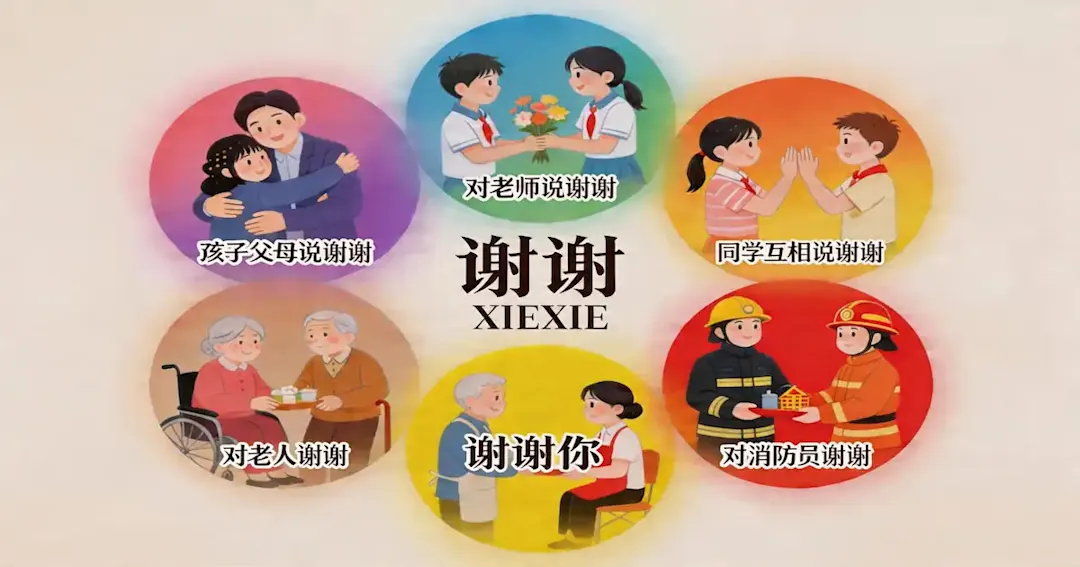

If you searched “xie xie meaning”, you probably want the quick answer _and_ the “don’t-make-it-weird” guide. Because yes—谢谢 (xièxie) means “thank you / thanks”. But kids (and adults) often get stuck at the one-word level, or they say it in the right moment with the wrong tone… and suddenly the confidence drops.Keep reading—this article will be helpful to you.
Xie xie meaning: what “谢谢” actually means
Xie xie meaning is straightforward: 谢谢 (xièxie) = thank you.
The interesting part is the shape of it:
谢 is tied to the idea of thanking (and also, in some contexts, excusing yourself).
谢谢 is that “thank” idea doubled, which in Mandarin can make something sound more natural and complete in daily speech.
So if your child only remembers one thing this week, let it be: 谢谢 = thank you.
When should kids use “xie xie” in real life?
If your child is 3–15, the best early goal isn’t “perfect vocabulary.” It’s being able to handle small social moments without freezing. Xie xie meaning matters because it’s a social tool—like saying “please” or “excuse me.”
A few very normal moments:
Someone hands them a snack at a playdate
A teacher helps them find a missing pencil
A grandparent sends a gift and they’re on a video call
A friend shares a toy (and your kid doesn’t know what to do with their hands)
Those moments add up. Kids who can respond smoothly tend to feel more “I belong here,” especially in bilingual situations.
Say it so it sounds natural: xie xie pronunciation without the stress
You can understand xie xie meaning perfectly and still get blank stares if the sound isn’t close enough. The good news: kids don’t need a lecture on tones. They need one reliable cue.
Try this pronunciation cue (works in a car, works while brushing teeth)
Think: STRONG–soft.
First syllable: xiè (it has a “falling” feel)
Second syllable: xie often becomes lighter and quicker in everyday speech
So it often comes out like: xiè-xie (with the second part shorter).
If your child is stretching it like “xièèè xieee,” gently tighten the second syllable. Not harshly. Just… shorter.

Use it correctly: step-by-step “thank you” scripts kids can actually say
Below are steps you can literally rehearse with your child. Each one is small on purpose. If you try to teach five phrases at once, it turns into performance anxiety. Ask me how I know.
Step 1: Say “xie xie” right after receiving something
Timing does a lot of the work. The easiest pattern is:
Receive → look up → smile → say 谢谢
Examples your child can copy:
Adult: “Here’s your juice.”——Child: “谢谢!”
Teacher: “Nice job cleaning up.”——Child: “谢谢!”
Friend’s parent: “You’re welcome to have one.”——Child: “谢谢!”
If your child whispers it, that’s still a win. The goal is: they use it.
Step 2: Add “ni” or “nin” when you want to sound extra polite
Here’s where xie xie meaning expands a bit.
谢谢你 (xièxie nǐ) = “Thank you” to someone you’re familiar with (friends, siblings, peers)
谢谢您 (xièxie nín) = “Thank you” in a more polite way (teachers, elders, strangers)
For many families, a simple rule is enough:
Use 谢谢你 for friends.
Use 谢谢您 for teachers and grandparents.
Will your child get it wrong sometimes? Yes. And it’ll still be fine.
Quick scripts:
“谢谢您,老师。” (Thank you, teacher.)
“谢谢你帮我。” (Thanks for helping me.)
“谢谢您给我这个。” (Thank you for giving me this.)
Step 3: Name the reason (this is the “sounds mature” upgrade)
If your child can add just one short reason, it stops sounding like a robot learned one button phrase. And it quietly builds sentence structure.
Use:
谢谢你 + 动作/帮助 (Thank you for + action/help)
Examples:
谢谢你帮我。 (Thanks for helping me.)
谢谢你等我。 (Thanks for waiting for me.)
谢谢您教我。 (Thank you for teaching me.)
Even if the grammar isn’t perfect, the social meaning lands.
If your child understands “xie xie” but won’t say it out loud, a guided speaking class can help. Book a LingoAce trial class to practice real-life thank-you scripts with a teacher.

Step 4: Choose a stronger “thanks” when it’s more than small help
Sometimes xie xie meaning (“thanks”) feels too small—like when a teacher spends extra time, or someone hosts your child for a birthday party.
Easy upgrades:
非常谢谢你/您 (very thanks… kids will say it; it’s okay, but a bit childish)
Better natural options:
- 真的谢谢你/您。 (Really, thank you.)
- 太感谢了。 (So grateful / thank you so much.)
- 麻烦你了,谢谢。 (Thanks for the trouble—polite, common, slightly advanced)
For kids, I’d keep it to:
真的谢谢您。
太感谢了。
One of those, done well, is more useful than ten fancy phrases they never use.
Step 5: Practice the reply
This part gets overlooked, then your child gets thanked and just… smiles and walks away.
Common replies:
不客气 (bú kèqi) = “You’re welcome” (polite, common)
不用谢 (bú yòng xiè) = “No need to thank me” (casual, friendly)
没关系 (méi guānxi) = “It’s okay / no problem” (more like “no worries”)
Kid-friendly practice:
Parent: “谢谢你!”——Child: “不客气!”
Parent: “谢谢!”——Child: “不用谢!”
It’s a tiny call-and-response. Like a game. Keep it light.
FAQ
1) What is the “xie xie meaning” in English?
Xie xie meaning is simply “thank you” or “thanks.” It’s the most common everyday way to express gratitude in Mandarin, and kids can use it in almost any polite situation.
2) What are the “xie xie tones”, and why does the second syllable sound shorter?
In careful speech, the first syllable is pronounced with a falling tone (xiè). In everyday speech, the second syllable often becomes lighter and quicker, which is why it can sound shorter. If your child says the second part too strongly, it may sound less natural—but it will still be understood.
3) Should my child say “xie xie ni” or “xie xie nin”?
A helpful rule: use 谢谢你 with friends and people your child knows well, and use 谢谢您 with teachers, elders, and unfamiliar adults. If your child isn’t sure, 谢谢您 is the safer “polite default” in public settings.
4) What’s the difference between “xie xie vs gan xie”?
谢谢 is the everyday “thanks.” 感谢 (gǎnxiè) is more formal and can feel more “written” or “serious,” like when you’re expressing deeper gratitude. For most kid situations, xie xie meaning + usage covers what they need.
5) How do you respond to “xie xie”?
Common replies include 不客气 (“you’re welcome”), 不用谢 (“no need to thank me”), and 没关系 (“no problem / it’s okay”). For kids, 不客气 is a great default because it’s polite and widely used.
Conclusion
So—xie xie meaning is “thank you,” but the real win is getting your child to use it naturally: at the right time, with a small smile, and with a backup reply when they’re thanked.And if your child needs more speaking confidence (or you’re tired of being the practice partner), booking a LingoAce trial class can be a low-pressure way for them to practice these mini social scripts with a teacher—especially pronunciation and real conversation timing—so “thank you” becomes something they can actually use outside the house.