If "time in Chinese" is on your list of things to learn, you're probably not doing it for fun facts. You're doing it because time shows up everywhere: class schedules, bedtime, "we're leaving in 10 minutes," even those tiny arguments that start with "You said 7:30!" and end with... well, you know.
This guide is aimed at parents in North America (especially those with kids aged 3–15) who want something practical: the correct patterns native speakers use, plus a simple way to practice at home without turning your kitchen into a language classroom.
Quick “copy-ready” cheat lines
现在几点(了)? (What time is it now?)
现在两点(钟)。 (It’s 2:00.)
现在两点整。 (It’s 2:00 sharp.)
现在两点半。 (It’s 2:30.)
现在三点一刻。 (It’s 3:15.)
现在差一刻四点。 (It’s 3:45.)
Step 1 — Memorize the building blocks for time in Chinese
Before your child can say time in Chinese smoothly, they need a small set of “lego pieces.” The good news: it’s not a huge list.
Core words you’ll use all the time in Chinese
Meaning | Chinese | Pinyin | Parent note |
o’clock | 点 / 点钟 | diǎn / diǎn zhōng | 点 is super common; 点钟 is a bit more explicit |
minute | 分 | fēn | Kids can learn this early |
half past | 半 | bàn | The easiest “shortcut” time word |
quarter | 一刻 | yí kè | Useful, but not required on day one |
“to” (before next hour) | 差 | chà | This is where things start sounding natural |
sharp / exactly | 整 | zhěng | Great for school schedules |
A quick clarification that trips up a lot of families: 点 and 点钟 both work for “o’clock.” If your child says 点 every time, it’s not wrong. Some parents overcorrect this and create stress. Don’t.

“AM/PM” in time in Chinese (people don’t really say AM/PM)
Time of day | Chinese | Pinyin | Rough match |
early morning | 早上 | zǎoshang | early AM |
morning | 上午 | shàngwǔ | AM |
noon | 中午 | zhōngwǔ | around 12 |
afternoon | 下午 | xiàwǔ | PM |
evening/night | 晚上 | wǎnshang | evening/night |
If you’re a parent, here’s the practical win: adding 下午 / 晚上 instantly reduces confusion. “7:00” is vague. “晚上七点” feels like a real sentence you’d say in life.
Step 2 — Build the basic sentence pattern for time in Chinese
The most common “tell time in Chinese” structure is simple:
[Time-of-day] + [Hour] + 点 + [Minutes]
Examples:
下午三点。 (3:00 PM)
上午九点十分。 (9:10 AM)
晚上八点半。 (8:30 PM)
中午十二点。 (12:00 noon)
The small-but-important “two” rule
When saying “2 o’clock,” native speakers usually say 两点 (liǎng diǎn), not 二点 (èr diǎn). It’s not that 二 is “illegal.” It just sounds stiff in daily speech.
两点 feels normal
二点 feels like reading numbers off a form
If your child says 二点 because they learned 二 first, don’t panic. You can gently model 两点 and they’ll pick it up.
“What time is it?” in time in Chinese
The go-to question is:现在几点?
or slightly softer / more conversational:现在几点了?
Answer patterns:
现在七点。
现在晚上七点。
现在七点五分。
If you only teach one thing this week: teach 现在几点? and five answers. That’s already functional time in Chinese.
Step 3 — Add half and quarter correctly in time in Chinese
This is where kids usually feel a “click.” Because it’s chunk-based, not math-heavy.
Use 半 for :30
三点半 = 3:30
八点半 = 8:30
You can even skip 分 at first. For kids, 半 is the “I can do this!” moment.
Use 一刻 for :15 (and sometimes for :45)
三点一刻 = 3:15
七点一刻 = 7:15
You may also see:
三点三刻 = 3:45
But in real speech, 差… is often used for :45 (more natural). We’ll get there next, because that’s the part many learners avoid… until they suddenly need it.
Step 4 — Switch to the 差… pattern for time in Chinese
If you want your time in Chinese to sound natural, you need 差.
Think of 差 as “to” the next hour.
Template: 差 + [minutes] + [next hour] 点
Examples:
七点五十 = 7:50
Natural alternative: 差十分八点 (10 minutes to 8)
七点四十五 = 7:45
Natural alternative: 差一刻八点 (a quarter to 8)
Notice the mental shift: you’re talking about the next hour.
A mini “don’t mess this up” note
English speakers often do this wrong at first: they keep the current hour by habit.
Wrong logic: “7:45… so I’ll say 7 something”
Chinese logic: “It’s almost 8… so I’ll reference 8”
If your child mixes it up, that’s normal. Correcting it is mostly repetition, not explanation. You model it a few times; their brain catches the rhythm.
If your child can say a few times but still freezes in real conversation, that’s usually a sign they need more guided speaking practice (not more vocabulary). A structured program like LingoAce’s live classes can help because it nudges kids touse_ time phrases in real dialogues—teachers can prompt, rephrase, and keep it moving. If you want, you can book a LingoAce trial class and use “telling time” as the theme for the level check.

Step 5 — Fix the common mistakes people make with time in Chinese
This is the part where parents usually say, “Ohhh, that’s why it sounded weird.”
点 vs 点钟 (do we need both?)
In daily speech:
两点 is very common
两点钟 is also correct, just a bit more explicit
A practical rule: If your child is learning, 点 alone is enough for now. Later, they’ll naturally hear 点钟 and imitate it.
Where time goes in a sentence
In time in Chinese, time phrases often appear early in a sentence:
我们三点半出发。 (We leave at 3:30.)
晚上七点有课。 (There’s class at 7 PM.)
下午两点去图书馆。 (Go to the library at 2 PM.)
This matters because parents often want their kids to do more than answer “what time is it.” They want them to say real things: “Class starts at…”, “We’re leaving at…”.
“12:05” and tiny minutes
Kids sometimes get stuck on “leading zeros.” In time in Chinese, you can simply say:
十二点零五分 (12:05)
In casual speech, people may also just say:
十二点五分 (context helps)
If you’re teaching a child, 零五分 is a nice “correct” model, but don’t turn it into a battle.

Step 6 — Practice time in Chinese at home with a 5-minute routine
Parents don’t need more homework. You need something you can actually repeat… on a weekday… when dinner is half-cooked.
Here are three tiny routines that work.
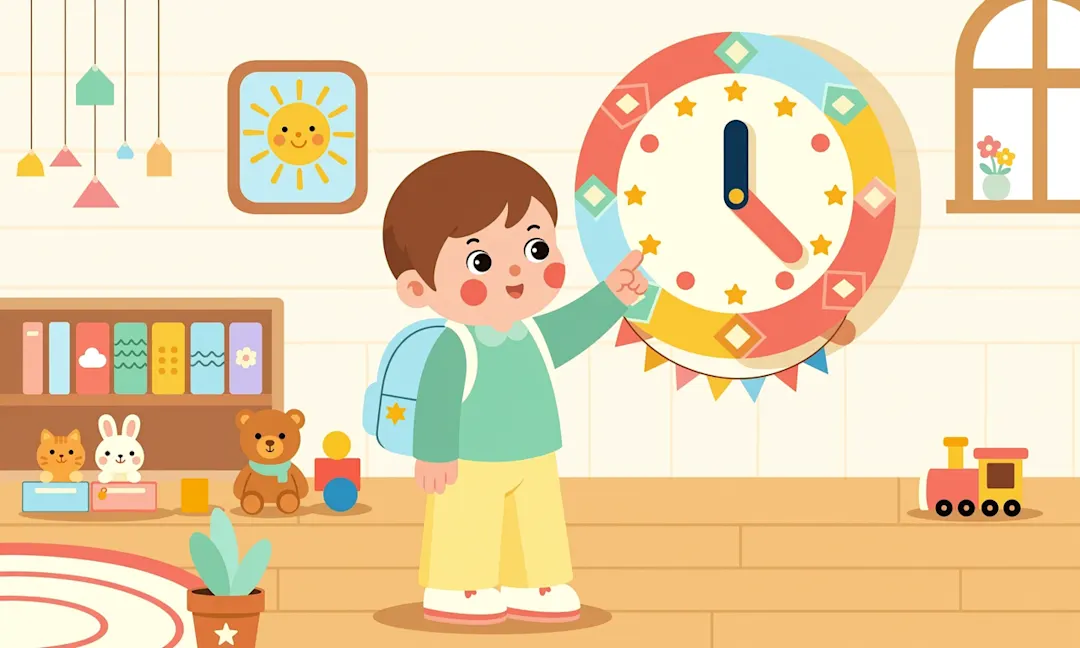
Routine A: “Clock check” game (60 seconds)
Once a day, you point at the clock and ask:
现在几点了?
Your child answers. If they answer in English, you repeat it in Chinese and have them copy once. That’s it.
Routine B: “Schedule talk” (2 minutes, real life)
Pick one daily anchor:
bedtime
class time
sports practice
Then say one sentence using time in Chinese:
我们晚上八点睡觉。
下午四点有钢琴课。
Your child repeats or responds:
好。
我知道。
Or even a silly complaint. Complaints count as language too, honestly.
Routine C: “Timer challenge” (2 minutes)
Set a timer for 10 minutes and say:
十分钟以后,我们走。 (In 10 minutes, we leave.)
Then ask again when it’s almost done:
现在差几分钟? (How many minutes left?)
This builds real-world time sense in time in Chinese without worksheets.
FAQ
1)How do you say “What time is it?” in time in Chinese?
Most common: 现在几点? Also common: 现在几点了? (a bit more conversational). Answer with [time-of-day] + [hour] + 点 + [minutes].
2)What’s the difference between 点 and 点钟 in time in Chinese?
Both mean “o’clock.” 点 is extremely common in speech; 点钟 is slightly more explicit. For kids, learning 点 first is totally fine.
3)How do you say AM and PM in time in Chinese?
People often use 早上/上午/中午/下午/晚上 instead of “AM/PM.” Example: 下午三点 (3 PM), 晚上八点半 (8:30 PM).
4)How do you say 7:45 in time in Chinese?
Two common ways:
七点四十五分 (straightforward)
差一刻八点 (more natural for many speakers)
5)What’s the easiest way to teach time in Chinese to kids?
Use short routines: a daily “clock check,” one schedule sentence per day, and a timer game. Keep it tiny and repeatable—5 minutes beats 50 minutes.
Conclusion
Learning time in Chinese doesn’t require a giant curriculum. It’s mostly a handful of patterns you repeat until they stop feeling like math.And if you’re at the stage where your child can repeat phrases but can’t use them when it matters, that’s a normal plateau. This is where guided speaking practice helps.
If you’d like a teacher to check your child’s level and build a simple path from “knows the words” to “can actually use time in Chinese,” you can book a LingoAce trial class. It’s a low-pressure way to see what your child can do right now—and what to focus on next.