In families around the world, jigsaw puzzles have transcended generations with their unique charm, becoming an important medium for parent-child interaction. For overseas Chinese families, puzzles are more than just a simple pastime; they carry the weight of education, especially in the learning of Chinese language and culture. This article will delve into the history and cultural value of puzzles, as well as how they can be cleverly integrated into Chinese education, providing overseas Chinese children with an interesting and educational learning experience.
History and Cultural Significance of Puzzles
The history of puzzles is long-standing, tracing back to the 1760s in England, where they were invented by mapmaker John Spilsbury to teach geography. He pasted a world map onto wood and cut along national borders, creating the world's first jigsaw puzzle. Today, puzzles have become a popular pastime in families across the globe, with a variety of forms and themes ranging from simple children's cartoon images to complex works of art. Puzzles have undoubtedly become a cultural phenomenon. In China, puzzles serve not only as tools for intellectual development but also as a means of passing down traditional Chinese culture. For instance, puzzles themed around the classic Chinese painting "Along the River During the Qingming Festival" offer a way for people to appreciate and learn about ancient Chinese art while engaging in play.

Puzzles and Child Development
Puzzles play a crucial role in the growth of children. They exercise cognitive abilities such as shape recognition and spatial perception, which are foundational skills for early development. Puzzles also enhance hand-eye coordination and fine motor skills, essential components of problem-solving. As psychologist Jean Piaget stated, "Play is the work of childhood, and toys are the child's tools." Puzzles are one such tool, fostering patience and focus in children's play and laying a solid foundation for their future learning and life.
Role of Puzzles in Family Bonding Activities
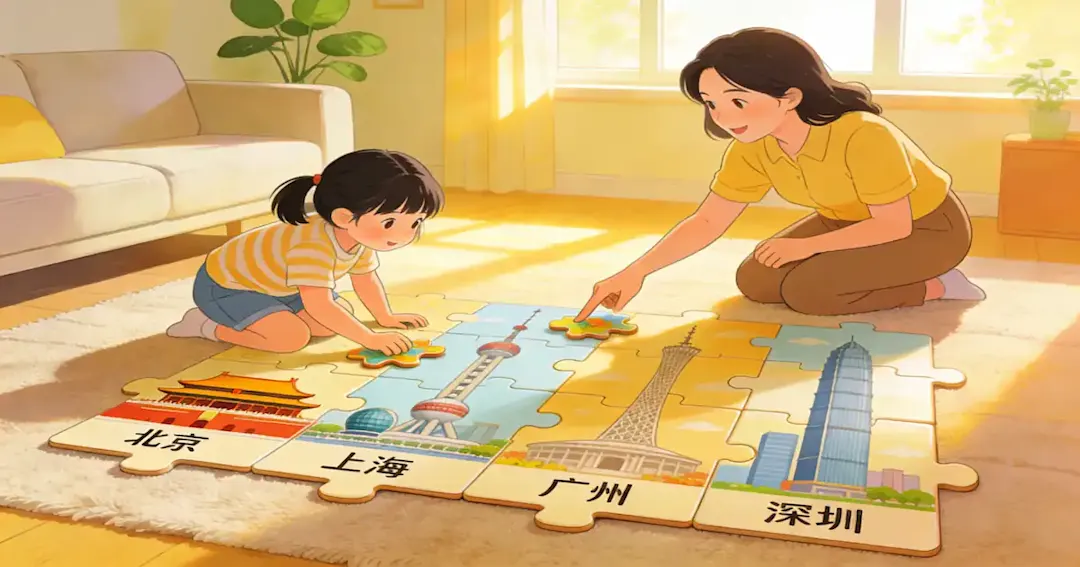
In the hustle and bustle of modern life, puzzles provide a platform for family members to engage together. They not only enhance interaction within the family but also foster the development of parent-child relationships. Facing the challenge of puzzles together strengthens communication and cooperation among family members. Moreover, creative puzzle designs and games can spark the creativity of family members, bringing more fun to family life. For example, parents and children can tackle a puzzle featuring world landmarks, which not only promotes collaboration within the family but also educates children about world cultures and history through play.
Conclusion: Combining Puzzles with Learning Chinese
In overseas Chinese families, jigsaw puzzles are not just a global form of entertainment but also an educational tool that combines learning with fun. In an overseas environment, where children have limited opportunities to engage with the Chinese language and culture, puzzles can serve as a unique teaching aid, helping them learn Chinese naturally through play.
Chinese learning toys, especially puzzles, can be designed to include Chinese characters, idioms, historical stories, or geographical knowledge of China. Such designs not only capture the attention of children but also subtly increase their understanding and interest in the Chinese language and culture as they piece together each part of the puzzle. For instance, a puzzle themed around the Chinese zodiac not only allows children to learn related vocabulary but also introduces them to traditional Chinese culture and festivals. As they assemble the zodiac puzzle, parents can share stories and characteristics associated with each animal sign, such as the hardworking ox or the clever monkey, making the learning process interactive and engaging.

Furthermore, parents can use puzzle time to narrate traditional Chinese stories or historical events related to the puzzle's imagery. This interactive learning method can better capture children's attention and make learning more vivid and interesting. For example, a puzzle depicting the "Along the River During the Qingming Festival" is not just a picture; it contains rich historical and cultural information. Parents can describe scenes of life during the Song Dynasty while assembling the puzzle, providing children with a deeper understanding of Chinese history through a dual visual and auditory experience.
In summary, puzzles as an educational tool have a value that goes far beyond simple entertainment. For overseas Chinese families, they offer a way to educate children about the Chinese language and culture in a relaxed and enjoyable atmosphere. With the emergence of more and more creative puzzle designs, there is good reason to believe that puzzles will continue to play a unique role in the field of education.
Consider letting your child learn Chinese! Chinese is the gateway to China's long history and unique culture.
At LingoAce, each course is the result of our team's over a hundred hours of course design, textbook production, simulated teaching, teacher training, and quality control. We invite you and your child to participate in a free trial class and experience LingoAce's extraordinary Chinese learning experience firsthand!