

With the recent release of the PSLE exam results in Singapore, the PSLE chatter amongst parents of primary school children may include conversations of whether your child should embark on the journey of taking up Higher Chinese in primary school. The perceived difficulty level of Higher Chinese may evoke reservations, leading to uncertainty about its suitability. If you're navigating through this decision-making process, this article is tailored for you. We'll delve into the nuances of Higher Chinese, addressing concerns and shedding light on the grading system, PSLE merit marks, and the importance of Higher Mother Tongue. By exploring these aspects, we aim to provide clarity on whether Higher Chinese is the right path for your child's educational journey in a Singapore primary school.
What is Higher Chinese in Primary School?
Higher Chinese is a advanced subject tailored for students with a strong passion for mastering the Chinese language. It is designed to provide students with an enriched learning experience beyond the standard Chinese syllabus to foster a higher order linguistic and language mastery in Chinese.

How Does Higher Chinese Differ From Standard Chinese?
Compared to standard Chinese, Higher Chinese goes beyond the standard curriculum, placing significant emphasis on refining your child's writing skills, deepening their language comprehension. In terms of the assessment structure, higher Chinese also has no listening and oral components, and only includes the Composition writing and the written comprehension paper components.
Paper | Component | Marks | Weightage |
1 | Composition Writing (写作) | 40 | 40% |
2 | Comprehension Paper (语文应用与阅读理解) | 60 | 60% |
Total |
| 100 | 100% |
It also encompasses 20-30% more vocabulary compared to the regular curriculum, challenging students to deepen their linguistic proficiency, with a learning objective of having a commendable proficiency in Chinese idioms.

Priority Enrollment in Special Assistance Plan (SAP) Schools
Encouraging your child to take up Higher Chinese in primary school could prioritize their admission to secondary schools with Special Assistance Plans (SAP). Initiated by the Singaporean government in 1979, the SAP program aims to support academically excellent students proficient in both their mother tongue and English. SAP schools, commonly known as "Special" schools, implement a curriculum allowing your child to use their mother tongue as the primary language alongside English.
With top schools including Hwa Chong Institution, Dunman High and more being in the list, choosing Higher Chinese becomes a strategic move for parents aspiring to secure admission to these SAP schools.
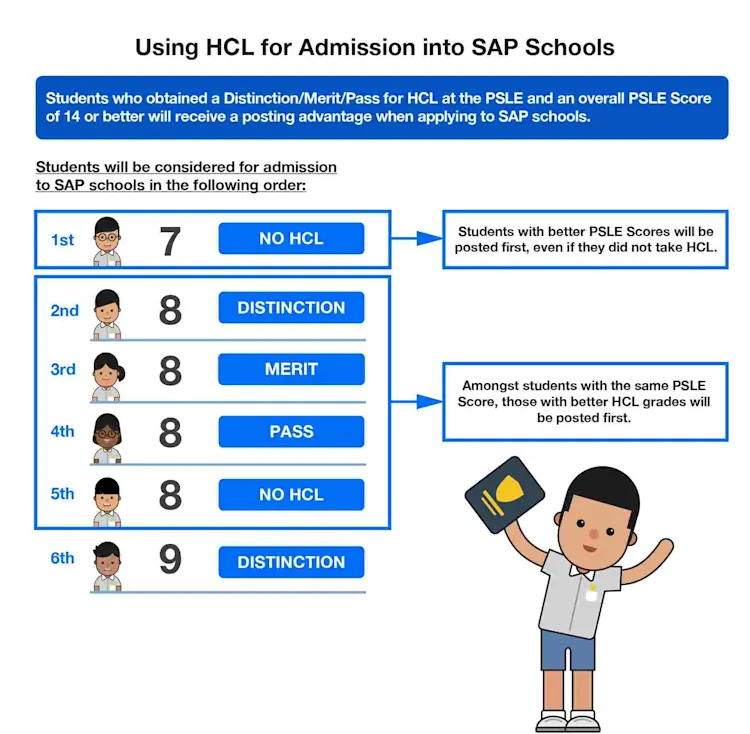
Source: MOE Students who have at least a pass in HCL and has a PSLE Chinese AL Score of ≤ 14 will be eligible for posting advantage to SAP secondary schools, making it an attractive option. The benefits extends beyond academic excellence, encompassing a cultural and bilingual educational approach. By opting for Higher Chinese, your child also gains a competitive edge and alignment with the ethos of SAP schools, where proficiency in both English and the mother tongue is highly valued.

Building a Robust Foundation in Chinese
While some parents may question the necessity of Higher Chinese, especially if their child doesn't plan to attend a Special Assistance Plan school, it's crucial to recognize that the journey of mastering the Chinese language extends well beyond the Primary School Leaving Examination (PSLE).
Secondary school marks a continuation of language studies, with students choosing either standard or Higher Chinese. For those enrolled in SAP schools, the commitment to Higher Chinese starts early, beginning from Secondary 1. This underscores the importance of establishing a robust foundation in Chinese during the primary years. Regardless of future educational paths, the advanced language skills developed through Higher Chinese contribute significantly to a student's linguistic versatility and cultural understanding.
The comprehensive nature of Higher Chinese not only broadens your child's vocabulary but also deepens their understanding of the Chinese language. Your child, as an adept Higher Chinese student, will likely experience a significant enhancement in their proficiency in standard Chinese. This linguistic mastery is not confined to academic realms but extends to practical, everyday communication, fostering a well-rounded language skill set.

Recognizing the increased complexity of secondary school Chinese, establishing a solid foundation in Primary School proves to be paramount. Furthermore, in Singapore's bilingual environment, proficiency in Chinese not only empowers your child academically but also unlocks doors to personal and professional opportunities in the future.
Additionally, choosing Higher Chinese isn't solely about meeting immediate academic requirements. It's an investment in your child's long-term language proficiency, cultural appreciation, and adaptability in Singapore's multicultural and bilingual environment. This foresighted approach ensures that your child is well-prepared for the linguistic challenges and opportunities that extend beyond the primary school phase.
Advantages of Higher Chinese in Secondary School & Beyond
The benefits of Higher Chinese extend beyond the immediate transition to secondary school and impacts the O-Level national examinations. With just a C6 in O-Level Higher, taking up Higher Chinese can translate into a reduction in 2 points, which is the equivalent of 2 grades in the O-Level examinations. This provides a significant advantage when seeking admission to junior college and other tertiary instituitions in a highly competitive landscape.

Should students choose to enroll in a Junior College for post-secondary education, they may be exempted from taking the Mother Tongue subject in Junior College. This makes Higher Chinese not just useful for secondary school, but also a strategic choice for post-secondary education pathways. Beyond that, some universities and programs, both locally and internationally, may also view candidates with excellence in Higher Chinese favorably. In an increasingly globalized world valuing cultural diversity, a solid foundation in Chinese language and literature sets individuals apart in the competitive realm of university admissions.
Is Higher Chinese Right For Your Child?

To qualify for Higher Chinese, schools typically consider a student's year-end results in Primary 4 before extending offers for Higher Chinese enrollment in Primary 5. Amidst the increased difficulty of Higher Chinese, one might question the reasoning behind choosing this path for your child. For many parents, the following points below are crucial considerations to consider. First of all, opting for Higher Chinese comes with a heavier workload, including additional lessons and nearly twice the amount of Chinese homework. . This requires strong self-discipline and effective time management, especially as Science is introduced from Primary 3 onwards, adding to the demands of English, Math, and now four core subjects by upper primary.

With the added vocabulary and rigor of the Higher Chinese curriculum, your child should have a genuine interest in the language to stay engaged with the more complex material. A strong foundation in basic Chinese skills is also essential — it builds the confidence needed to write clearly and coherently, which is key to succeeding in Higher Chinese.

How LingoAce Can Help
By incorporating supplementary resources such as LingoAce’s Chinese classes - which provides higher chinese curriculum from P1 onwards into your child's education, you can empower your child with additional tools to succeed in Higher Chinese and beyond. The interactive nature of LingoAce’s online learning can further enhance their language skills, providing a well-rounded approach to mastering Mandarin. In conclusion, the decision to take up Higher Chinese, should be based on whether your child likes Chinese, as his/her time management skills due to the demand nature of the subject. Taking into consideration the extra classes and Chinese homework, your child should be confident in doing equally well in other subjects to fully enjoy the benefits that Higher Chinese offers.
From the perspective of cultural heritage, ensuring that our children excel in Mandarin is the responsibility of every parent. Consider how Southeast Asian Chinese communities strive to preserve Chinese culture in challenging environments, we may observe how Chinese schools in Malaysia resiliently endure adversity. In comparison in Singapore, where even by the second generation, many children nearly abandon the Chinese language. It truly evokes a sense of lamentation and concern.
For more information on our LingoAce Chinese programmes and the latest promotions, contact us for a free trial class now! We offer a variety of programs and services to help students of all levels to improve their Chinese language skills.

For our avid blog readers, simply visit our page, sign up for a free trial and receive additional 2 free lessons after purchasing a package with us! Find Out More!