

Key Takeaways:
How Learning Key Math Concepts Supports Preschoolers’ Development
Understanding numbers as quantities helps preschoolers build strong foundations for arithmetic and problem-solving.
Exploring shapes, patterns, and sequences strengthens logical thinking, memory, and attention, which are essential for everyday reasoning.
Through comparing, sorting, measuring, and play-based problem-solving, children develop confidence, adaptability, and readiness for primary school learning.
Introduction
Preschool is a critical stage for shaping how children perceive learning, especially when it comes to mathematics. During these early years, children naturally observe patterns, quantities, shapes, and relationships in their surroundings. These observations help them to make sense of everyday experiences. Rather than focusing on memorisation, early maths learning builds on this natural curiosity through hands-on interaction, questioning, and simple problem-solving.
This article outlines the essential math concepts that build your child’s foundational numeracy skills. It explains how these topics support preschoolers in developing confidence and readiness for primary school learning.
What Are the Core Math Concepts Every Preschooler Should Learn?
1. Number Recognition and Counting
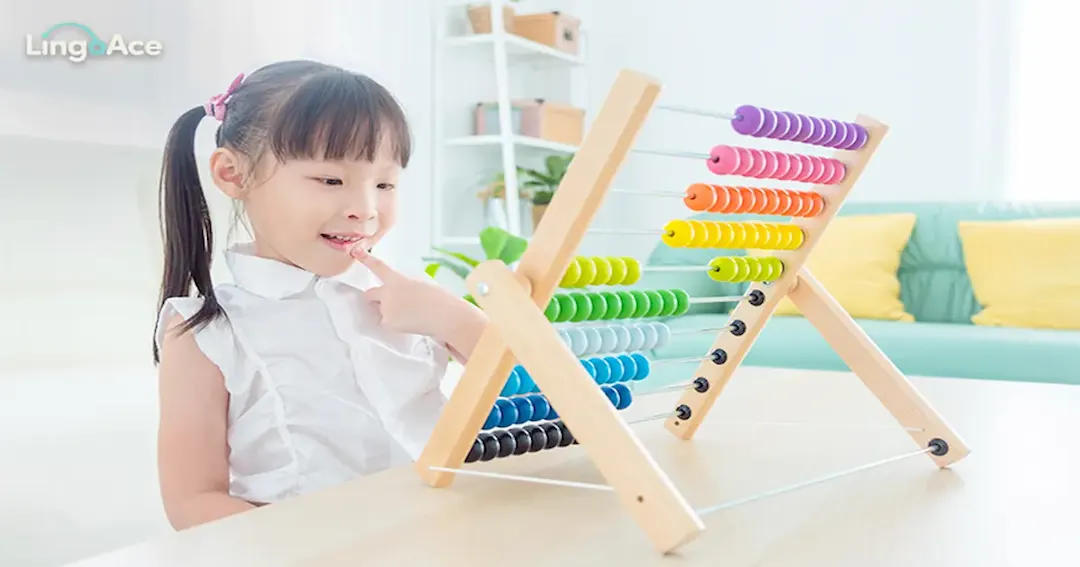
Number recognition is more than knowing how to recite numbers in order. It involves understanding that numbers represent quantities and that each number corresponds to a specific amount. Counting helps children grasp ideas such as “more,” “less,” and “how many,” which are central to later arithmetic.
Over time, they begin to notice when items are missing or when a group has more or fewer objects, showing growing number awareness. This skill is crucial because it forms the basis of addition, subtraction, and problem-solving in later years.
2. Shapes and Spatial Awareness
Learning about shapes helps preschoolers understand how objects fit together and relate to one another in space. Spatial awareness supports skills such as direction, position, and movement, all of which play a part in geometry and early reasoning.
Through exposure to shapes, children learn to notice similarities and differences, rotate objects mentally, and understand basic properties like edges and corners. These abilities later support tasks such as reading graphs, solving puzzles, and even handwriting.

3. Patterns and Sequencing
By recognising patterns, children begin to understand order, relationships, and what comes next. Sequencing activities reinforce the idea that actions and events follow a logical progression. This is essential for mathematical thinking and everyday reasoning.
Recognising patterns also strengthens memory and attention skills. When children can anticipate what comes next, they learn to make more informed decisions and stay focused on tasks. These skills are often reinforced through structured learning environments, including some online math tuition in Singapore.
4. Comparisons and Measurement
Measurement concepts introduce children to the relationships between quantities. Before learning formal units like centimetres or kilograms, preschoolers develop understanding through comparative language like heavier and lighter, taller and shorter, and fuller and emptier.
These comparisons build estimation skills and help children interpret their environment more accurately. For instance, when pouring water between containers, a child notices that a taller cup does not always hold more liquid. This discovery challenges assumptions and encourages deeper thinking about volume and capacity through real experience.
5. Sorting and Classifying
Sorting teaches children to group objects based on shared characteristics, such as colour, size, or shape. This math concept strengthens logical reasoning and helps children understand categorisation, which is foundational for data handling and organisation.
Classifying also encourages children to explain their choices, reinforcing reasoning skills and verbal expression. These skills later support mathematical explanations and structured thinking.
6. Problem-Solving Through Play
Problem-solving helps children explore ideas, make choices, and understand the consequences of their actions. Through play-based activities, preschoolers learn to persist when tasks feel challenging. When something does not work, they know how to adapt their thinking and approach problems more confidently.
At this stage, the emphasis is not on arriving at the correct answer, but on engaging in the thinking process itself. Through repeated experiments, children develop resilience and a positive attitude towards learning.
How LingoAce Supports Early Math Foundations
Strong early maths foundations are built through understanding rather than acceleration. When children explore mathematics through meaningful, age-appropriate preschool math learning activities, they gain confidence, curiosity, and problem-solving skills that support learning beyond mathematics. These early experiences help lay the groundwork for their long-term success.
At LingoAce, early maths learning is thoughtfully designed to match how preschoolers naturally learn. Aligned with the Singapore MOE syllabus, our math online classes encourage young learners to ask questions, make connections, and apply what they learn to everyday experiences. At the same time, they also support a smooth transition into more structured primary school mathematics.
For parents considering math tutoring online, this approach keeps early learning engaging and aligned with curriculum expectations. Essentially, we leverage interactive lessons, guided exploration, and visual storytelling to help your child understand key math concepts in context rather than in isolation.
Get in touch to discover our programmes.