

Introduction
Many children struggle with mathematics, not because they dislike numbers, but because mathematical thinking has not yet taken root. This is what helps children make sense of numbers, recognise patterns, reason logically, and approach problems confidently. Without this foundation, maths can feel like a set of rules to memorise rather than ideas to understand.
When nurtured early, this mindset allows children to move past rote calculation towards real understanding. More importantly, it builds learning confidence while strengthening problem-solving skills and critical thinking in mathematics education.
In this article, we look at what mathematical thinking involves and why it is important for every child. We then explore practical ways parents and educators can support its development.
Key Takeaways:
1. What is mathematical thinking?
It focuses on how children reason, make connections, and solve problems by understanding ideas rather than memorising steps.
2. Why is mathematical thinking important for children?
It supports logical reasoning, problem-solving skills, and confidence, helping children approach learning and everyday challenges more thoughtfully.
3. At what age should children develop mathematical thinking?
This way of thinking can be nurtured from the preschool years, when children naturally explore patterns, quantities, and relationships through play.
4. How can parents support mathematical thinking at home?
Parents can ask open-ended questions, link learning to daily activities, and focus on a child’s reasoning instead of just correct answers.
5. How does tuition help strengthen mathematical thinking?
Structured guidance helps children explain their ideas, test strategies, and build deeper understanding rather than relying on rote methods.
Understanding Mathematical Thinking
What Is Mathematical Thinking?
Mathematical thinking can be described simply as thinking like a problem solver. Rather than relying on memorisation or carrying out calculations by routine, it focuses on understanding how ideas connect, why patterns occur, and how relationships work. Children learn to make sense of information and solve problems through reasoning rather than guesswork.
The process of developing mathematical thinking in children focuses on learning mathematics. It emphasises pattern recognition, generalisation, and relational reasoning, supporting a shift from step-by-step methods to true understanding. By developing these skills, children learn to approach mathematical challenges creatively and systematically, building a strong foundation that supports both current learning and future problem-solving.
How It Works
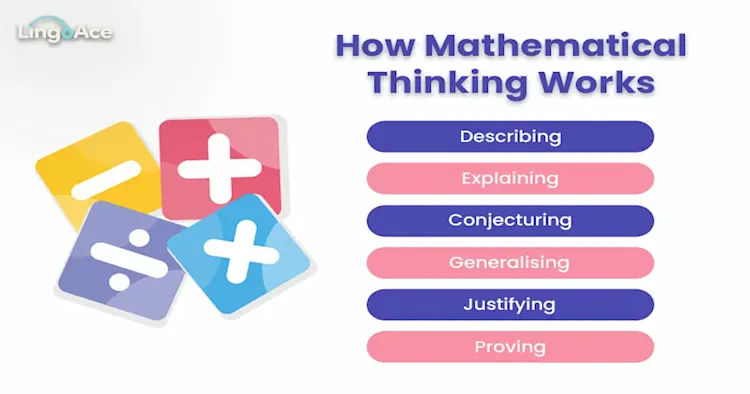
Understanding what quantitative reasoning is naturally leads to the question of how children use it in practice. In everyday learning, this shapes how children approach problems, explore ideas, and comprehend mathematical concepts.
The following reasoning skills help young learners to enhance conceptual understanding in mathematics:
1. Describing
Children learn to observe and clearly describe patterns, numbers, or relationships they notice.
Example:
A child may point out that the numbers 2, 4, 6, and 8 increase by two each time.
2. Explaining
Children develop the ability to explain why an answer is correct or incorrect, rather than just stating the result.
Example:
Through private math tuition, they are guided to articulate their reasoning step by step, building clarity and confidence in their thinking. For instance, they learn to explain why ¼ + 2/4 equals 3/4 and not ⅜ by recognising that the denominators must remain the same, and that only the numerators are combined.
3. Conjecturing
Children make predictions based on what they observe and test whether their ideas hold true.
Example:
A child might start by doubling 3 and get 6, which is even.
They then double 5 and get 10, also even.
Trying 7 × 2 = 14 and 12 × 2 = 24, they see that each result is still an even number.
4. Generalising
Children learn to extend patterns and observations to form broader rules or principles.
Example:
After working with several additional questions, a child may notice that:
3 + 5 = 5 + 3
7 + 2 = 2 + 7
10 + 4 = 4 + 10
From these observations, the child can generalise that the order of numbers does not affect the sum in addition. Instead of remembering each example separately, they form a broader rule that applies to all addition problems.
5. Justifying
Children use logical reasoning to support their answers and explain how they come to a conclusion.
Example:
When solving 24 ÷ 3, a child might justify their answer by explaining:
“I know that 3 × 8 = 24, so 24 ÷ 3 must be 8. I checked by multiplying to make sure my answer is correct.”
This shows the child is using logical reasoning and mathematical relationships to support their conclusion.

6. Proving
Children demonstrate why a mathematical idea works through clear and structured reasoning rather than assumptions.
Example:
A child may take two odd numbers, such as 5 and 7, and show why their sum is even:
5 can be grouped as 2 + 2 + 1
7 can be grouped as 2 + 2 + 2 + 1
When the groups are combined, the two 1s pair up to form another 2, leaving only groups of 2. Since the total can be fully grouped into pairs, the child proves that 5 + 7 = 12, which is even.
Together, these problem-solving skills for kids support learners in moving past just finding the correct answer. They build confidence in explaining their thinking clearly, without relying on rote methods.
Why Mathematical Thinking Matters
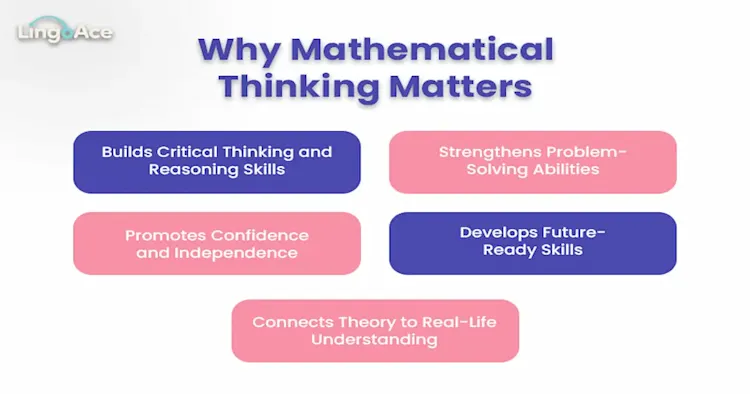
Building on these problem-solving foundations, numerical reasoning stands out as a key driver of a child’s overall development. More than just a maths skill, it shapes how children reason, learn, and approach challenges in everyday life.
Here’s why it matters:
1. Builds Critical Thinking and Reasoning Skills
Mathematical thinking encourages children to question ideas, explore different approaches, and justify their answers instead of memorising steps. By doing so, they strengthen logical reasoning and learn to evaluate multiple possibilities before reaching a conclusion. This ability to reason and compare outcomes helps children make thoughtful, evidence-based decisions rather than relying on guesswork.
During the preschool years, the brain forms neural connections rapidly, making this an ideal stage to nurture logical thinking through play, discussion, and exploration. When children engage with math in meaningful, hands-on ways early on, these critical thinking skills become a natural part of how they learn and reason.
2. Strengthens Problem-Solving Abilities
Rather than relying on familiar patterns, children learn to apply what they know to new or unfamiliar situations. As they learn to break problems into smaller, manageable parts and explore solutions, they develop flexibility and resilience in their thinking. This process-focused approach reduces math anxiety by shifting attention away from getting the “right answer” and towards understanding how to reach a solution.
As a real-world benefit, young learners who practise mathematical reasoning often perform better across all subjects and daily activities. Through real-world math applications for children, such as planning steps to solve a puzzle or comparing quantities while shopping, they learn to approach challenges methodically and persist even when tasks become difficult.
3. Promotes Confidence and Independence
A strong conceptual understanding helps children feel more confident when tackling challenging tasks. Mistakes are no longer seen as failures but as opportunities to learn and improve. This mindset supports independence, encouraging children to stay curious and discover new ideas as they work through problems.
For example, during math private tutoring, a child may use counters or number cards in a game to explore different ways of making a total of 10. With guided prompts from the tutor, the child tests methods, corrects mistakes, and explains their reasoning. This hands-on discovery allows the child to experience success independently, building confidence and supporting long-term engagement with math.

4. Develops Future-Ready Skills
Mathematical thinking strengthens analytical skills, such as pattern recognition, spatial awareness, and logical reasoning. These skills allow them to process information more effectively and make sense of complex ideas. At the same time, this thinking also improves executive function skills like working memory, focus, and cognitive flexibility. It enables children to keep information in mind, maintain concentration, and respond flexibly when situations change. Together, these abilities lay a strong foundation for future learning and careers that rely on data analysis, structured thinking, and informed decision-making.
5. Connects Theory to Real-Life Understanding
By applying math to everyday situations, children begin to see its relevance beyond the classroom. They learn that math is not limited to worksheets, but is a tool they use naturally in daily life. Whether recognising patterns in nature, estimating quantities while shopping, or making quick mental calculations, they practise practical reasoning in meaningful contexts. This helps math feel less like memorisation and more like a useful, creative skill, enhancing understanding and supporting learning across different subjects and daily experiences.
Nurturing Mathematical Thinking in Young Learners
How Parents Can Encourage
Building on the idea that mathematical thinking connects learning to real-life experiences, parents play an important role in shaping how children develop this mindset at home. Simple, everyday interactions can create meaningful opportunities for children to explore ideas, ask questions, and build confidence in their thinking.
Here are some practical ways parents can encourage this way of thinking:
1. Encourage Exploration and Questions
Allow children to explore ideas freely instead of providing immediate answers. Asking open-ended questions such as “How did you get that answer?” or “What would happen if we tried something different?” encourages children to reflect on their thought process. Over time, this helps them reason logically, articulate their thinking, and gain confidence in solving problems independently.
2. Connect Math to Everyday Life
Everyday activities offer rich opportunities to make math meaningful. Involve children in tasks like cooking, shopping, or planning outings. Comparing prices at the supermarket, measuring ingredients while baking, or estimating travel time helps children see that math exists beyond textbooks. These real-world connections show how math supports daily decision-making and practical problem-solving.
3. Use Games and Interactive Activities
Games provide a fun and engaging learning experience. Activities such as Sudoku, tangrams, and board games that involve counting, matching, or strategy encourage children to think critically while enjoying the process. When learning feels like play, children are more likely to stay curious, experiment with ideas, and remain engaged.
4. Praise Effort and Thinking, Not Just Correct Answers
Shift the focus from getting the right answer to valuing the thinking behind it. Praising effort, persistence, and logical reasoning reinforces the importance of mathematical thinking, helping children develop a growth mindset. For example, in a math enrichment class for primary students, a child solving a word problem about sharing 12 apples among 4 friends may give an incorrect answer.
Instead of focusing on the mistake, the parent might ask the child to explain each step they took. As the child talks through dividing the apples into equal groups, they may realise where their thinking went off track. This process helps the child understand the concept more clearly and builds confidence in explaining their reasoning, even when the answer is not yet correct.
How LingoAce Makes Math Meaningful
For parents who want to go beyond home-based activities and provide consistent guidance, a structured learning environment can further strengthen mathematical thinking. With the right support, children are able to build strong foundations while staying engaged and motivated as they learn.
For parents seeking structured yet engaging ways to nurture mathematical reasoning, LingoAce offers a balanced solution. As a Singapore-based PreK–12 online learning platform, LingoAce supports early math learning strategies through live, interactive lessons designed for children aged 3 to 15.
With the guidance of an experienced online math tutor, children benefit from dedicated teaching in one-on-one or small-group settings. Lessons are tailored to each child’s learning style and pace, allowing them to explore concepts deeply rather than memorise procedures. Through immersive learning experiences that simulate real-world scenarios, children apply math in meaningful contexts, helping ideas stick more naturally.
Real-time math online classes keep learners actively involved, with instant feedback that clarifies misunderstandings and strengthens confidence. Alongside this, comprehensive progress tracking and adaptive learning plans ensure every child receives the right level of support as they grow, building both mathematical understanding and long-term confidence.

Frequently Asked Questions
1. How is mathematical thinking different from doing math exercises?
Doing math exercises often focuses on getting the right answer through repetition. Mathematical thinking, on the other hand, encourages understanding why something works, exploring different methods, and applying logic to new situations.
2. How can parents encourage mathematical thinking at home?
Parents can nurture it by asking open-ended questions, connecting math to daily activities like shopping or cooking, and using puzzles or strategy games that promote reasoning and curiosity.
3. What role does mathematical thinking play in the Singapore Math curriculum?
Singapore’s MOE math curriculum places strong emphasis on reasoning, communication, and problem-solving. Students are encouraged to think critically, explain their thought processes, and apply concepts to real-world situations.
Conclusion
In the end, mathematical reasoning is about how children think, not just what they know. It shapes the way they reason, question ideas, and interpret their surroundings. By nurturing curiosity and critical thinking in everyday moments, parents help children see math as a practical tool for understanding real-life situations, not just a school subject.
Through interactive math lessons online, children are encouraged to explore, explain, and apply concepts meaningfully. As a trusted platform for online tuition in Singapore, LingoAce plays an important role in cultivating young problem-solvers. Our research-backed online programmes help children connect mathematical ideas to real-world contexts, building confidence, independence, and skills that extend beyond the classroom.
Seeking quality online maths tuition in Singapore for your child, LingoAce uses structured teaching to develop mathematical literacy. We also focus on nurturing attention, reasoning, memory, and confidence.
Get in touch to find a suitable class for your child.