



1. PSLE Chinese Journey: A Comprehensive Guide
The PSLE Chinese examination is a crucial milestone for students in Singapore, assessing their proficiency in Chinese listening, speaking, reading, and writing. Excelling in PSLE Chinese requires strategic preparation, a strong foundation, and familiarity with the MOE syllabus.
This guide provides a detailed breakdown of the PSLE Chinese exam format, essential study strategies, and resources to help students navigate the different components with confidence. Whether your child is preparing for the upcoming school exams, seeking Chinese tuition, or taking the PSLE this year, this resource will equip you with the necessary skills to succeed.
Additionally, we will outline key milestones from preschool to primary 6, including the transitioning from preschool to primary school, Primary 1 registration and more, to kickstart your child's academic journey. For parents looking ahead, understanding the PSLE al score system, PSLE banding, and the primary school grading system will provide clarity on the assessment structure.
By the end of this guide, you will be fully equipped to help your child achieve AL1 with effective revision methods and proven techniques to enhance their performance in PSLE Chinese. Let’s begin!
Key Components of the PSLE Chinese Exam
The PSLE Chinese Exam consists of four main sections:
✔ PSLE Chinese Composition (写作) – Tests writing skills, creativity, and language use.
✔ PSLE Oral Practice (口试) – Evaluates fluency, pronunciation, and ability to express opinions.
✔ Paper 2 (试卷二) – Assesses comprehension, grammar, and vocabulary application.
✔ PSLE Listening Comprehension (听力理解) – Measures a student’s ability to understand spoken Chinese.
Each of these components contributes to the final PSLE AL score, making it essential for students to develop a balanced skill set.
PSLE AL Score System & Banding
The PSLE Achievement Level (AL) Score System replaced the previous T-score system, offering a more progress-based assessment. Instead of being graded based on peer comparison, students are now placed into fixed AL bands (AL1 to AL8) based on their raw scores.

Why Strategic Preparation Matters: Starting Early
Achieving a strong PSLE AL score in Chinese isn’t about rote memorization or last-minute cramming—it requires early and consistent preparation from preschool to Primary 6. Building a strong foundation early helps students develop confidence, fluency, and mastery of the language naturally, making learning more effective and less stressful.
2. Foster Interest in Chinese During the Preschool Golden Period
The preschool years (N2–K2) are the golden period for language development, making it the best time to introduce Mandarin in a fun and engaging way. At this stage, children absorb new languages naturally through exposure and interaction rather than formal lessons.
Early Stage Learning Strategies & Recommended Resources
Introducing Mandarin at an early age through play-based learning helps children develop a natural love for the language. Using songs, storytelling, and interactive activities, parents can create a fun and immersive environment.
Everyday conversations in Mandarin, combined with hands-on activities like crafts, storybooks, and songs. This immersive language environment not only captures children's attention but also reinforce learning in an engaging way, capturing children's attention while enhancing their vocabulary and confidence in using Mandarin in real-life situations. Here are 3 resources your child can make use of:
1. Chinese Storybooks
Chinese storybooks play a crucial role in early literacy, helping children build vocabulary and understand sentence structures. Some great beginner-friendly books include:
《小熊宝宝》系列 (Little Bear Baby Series)
《好饿的毛毛虫》(The Very Hungry Caterpillar – Chinese Edition)
《猜猜我有多爱你》(Guess How Much I Love You – Chinese Edition).
To make reading even more engaging, LingoAce Ace Chinese Books App provides an interactive learning experience with animated storybooks, audio narration, and fun visuals. Designed for children aged 3 to 8, this app makes Mandarin reading accessible and enjoyable.
🔗 Claim Yours Now! 2. Chinese Nursery Rhymes (H4)
Nursery rhymes are also excellent for developing pronunciation, rhythm, and word recognition while making learning fun and engaging. Some classic must-know rhymes include:
《两只老虎》 (Two Tigers)
《拔萝卜》 (Pulling Radish)
《小星星》 (Twinkle Twinkle Little Star – Mandarin Version)
We’ve compiled a list of the top Chinese nursery rhymes along with lyrics and sing-along resources to help your child learn through music.
3. Chinese Cartoons
Watching Chinese cartoons is a top past time for kids, but it can also an educational experience to further enhances language exposure. Some of our recommended shows include:
《宝宝巴士》 (BabyBus) – Engaging educational videos for young learners.
《小猪佩奇》 (Peppa Pig – Chinese Version) – Fun and easy-to-understand dialogues.
《超级飞侠》 (Super Wings) – Entertaining storytelling with cultural elements.
Choosing the right Chinese cartoons can make language learning more effective by improving listening skills, vocabulary, and pronunciation. Check out our guide on selecting the best Chinese cartoons for your child! By incorporating play-based learning, engaging storybooks, nursery rhymes, cartoons, and reading clubs, parents can lay a strong foundation for their child’s Mandarin learning journey. To make early Mandarin learning easier, we’ve put together a free downloadable guide packed with: ✅ A Beginner-Friendly Chinese Storybook List ✅ The Top 10 Nursery Rhymes Every Child Should Know ✅ A Curated List of the Best Mandarin Cartoons & Apps

Preparing for P1 Registration and School Readiness
As your child approaches the K1–K2 stage, Primary 1 (P1) registration naturally becomes top-of-mind for many Singaporean parents. P1 Registration typically begins around July each year, and this marks the beginning of formal education for your child.
How to Choose the Right Primary School
1. Research & Shortlist Schools
Understand your child’s interests, language support needs, and school commute.
Use MOE SchoolFinder to compare schools' programmes and CCAs.
2. Attend School Open Houses (if time permits)
Get a feel of school culture, teaching methods, and facilities.
Speak to teachers, students, and staff to evaluate fit.
3. Check Balloting Stats & Vacancies
Review past admission data to assess school demand.
Understand how distance and school popularity affect chances.
4. “Every School a Good School” Mindset
Focus on finding a school that suits your child’s learning style and growth potential, rather than chasing rankings.
For a more detail guide, click here. Beyond selecting the right school and understanding MOE’s phases, a key concern often surfaces: “Is my child ready — especially for Chinese? – which we will cover in the next section.
Transitioning from K2 to primary school
The shift from preschool to Primary 1 is a significant milestone in a child's learning journey, bringing new academic expectations, structured learning environments, and a stronger focus on Chinese language proficiency. Early preparation can help ease this transition, ensuring that children build confidence and adaptability as they step into primary school. One of the biggest changes is the shift from play-based learning in preschool (MOE’s NEL Nurturing Early Learners Framework) to a structured curriculum (MOE’s Primary School Chinese Language Syllabus), where children are expected to engage in Hanyu Pinyin, sentence construction, and basic composition. Strengthening these foundational skills early can help children adjust smoothly to primary-level Chinese lessons.

Parents can support this transition by:
Reinforcing Mandarin through daily conversations and interactive reading 📖
Encouraging independent learning with simple writing and recognition activities ✍
Introducing structured lessons that mirror Primary 1 syllabus expectations 🏫
LingoAce Ace Chinese Preschool Program
At LingoAce, we believe that the key to long-term success in learning Mandarin starts with genuine interest and early exposure. Our program is designed to create a fun, immersive, and engaging environment where children naturally develop a love for the language through storytelling, songs, interactive games, and hands-on activities. Through our structured yet enjoyable approach, young learners experience Mandarin as a living language, making the transition to Primary 1 Chinese learning smoother and stress-free.
Preschool Review – What Parents Are Saying
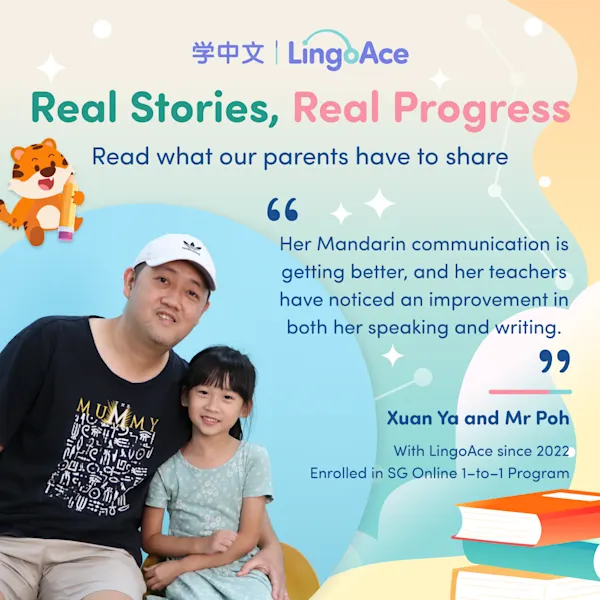
🌟 " With the short, yet effective online lessons with LingoAce over her preschool years, Xuan Ya managed to build a good foundation in her kindergarten years to allow her to transition easily into Primary 1 this year!!" – Mr Poh, Parent of Xuan ya, P2
3. Learning Milestones for Primary School
As children transition from preschool to primary school Chinese, it is important to understand the Key essential learning milestones at each stage of primary school to track your child’s progress. The primary school Chinese learning journey follows structured milestones that build a child’s reading, writing, listening, and speaking proficiency, aligned with the Singapore MOE syllabus.

In Primary 1 and 2, the focus is on Hanyu Pinyin, basic vocabulary, sentence construction, and oral communication, laying a strong foundation for language mastery. By Primary 3 and 4, students’ progress to longer texts, deeper comprehension, and more structured compositions, developing analytical skills and the ability to infer meaning. It is important to note that the number of new words doubles, while learning time lessens. In Primary 5 and 6, the emphasis shifts to advanced comprehension, critical thinking, and expressive writing, preparing students for the PSLE Chinese exam. The upper primary years also focus on fluency in conversational Mandarin, rhymes, and storytelling, fostering a deeper appreciation for the language.
An introduction to Primary School Subject-Based Banding (SBB)
Understanding learning milestones is crucial, but so is knowing how primary school assessments work. With the removal of Mid-Year Examinations (MYE), Weighted Assessments (WA1 & WA2) now play a crucial role in tracking students' progress throughout the year. Conducted termly, these assessments help identify strengths and areas for improvement before the final End-of-Year Examinations (EOYs). 📌 Key points to note about SBB & assessments: ✔ P1 & P2 Students: The Holistic Development Profile (HDP) assesses P1 & P2 students using qualitative descriptors (e.g., Developing, Competent, Accomplished) instead of grades. While they don’t have weighted assessments, they undergo 听写 (dictation), quizzes, and classroom exercises to reinforce learning and provide continuous feedback. This helps parents track progress and understand their child’s strengths and areas for improvement.

✔ P3–P6 Students:
Weighted Assessments (WA1 & WA2) are part of a structured learning-assessment cycle, allowing teachers to track progress and personalize learning plans. This approach reduces last-minute cramming, minimizes stress, and strengthens core Chinese language skills through consistent improvement.

💡 Want to support your child’s Chinese learning journey?
Curious about your child's Chinese proficiency? LingoAce offers a free personalised Chinese assessment—a fun and interactive trial class where our expert teachers evaluate your child's language skills.

📍 What to expect from the Free 1-to-1 Trial Class:
✅ Engaging activities to assess listening, speaking, reading, and writing skills ✅ Expert feedback and proficiency report from experienced Chinese language educators ✅ A customized learning path to help your child excel with confidence
🔗 Book a Free Trial Class Now!
4. Lower Primary (P1–P2): Strengthening Foundations
The Lower Primary years (P1–P2) are critical for building a strong foundation in Chinese language learning. At this stage, students begin to develop essential skills in Hanyu Pinyin, vocabulary, sentence structure, and oral communication, which lay the groundwork for more advanced Chinese learning in later years, ensuring a smooth progression into upper primary levels.
P1-P2 Key Areas Of Focus
1. Reading Skills (阅读技能)
By the end of P1–P2, students can recognize and understand 700–750 Chinese words, differentiating between 形 (form), 音 (sound), and 义 (meaning) along with Chinese radicals. They are trained to read passages fluently with proper intonation and extract key details from texts, improving comprehension skills.

2. Oral & Listening Skills (口语与听力技能)
Listening comprehension plays a crucial role in developing conversational abilities. Students are trained to identify key information such as people, events, times, places, and data from spoken passages. They also practice speaking in full sentences with proper pronunciation, tone, and clarity, enabling them to engage in basic conversations with confidence.


3. Writing Skills (写作技能)
Students learn to write 300–350 commonly used Chinese characters, following correct stroke order and structure. They also practice forming grammatically correct sentences, which helps them express ideas clearly in written form.

Learning of Chinese Characters start from Hanyu Pinyin
Hanyu Pinyin is a fundamental building block in early Chinese language learning, enabling children to develop pronunciation accuracy, improve reading fluency, and connect sounds with written characters. By mastering Pinyin in Primary 1, students establish a strong foundation for literacy, comprehension, and digital communication, essential for both academic success and daily life.
✅ Boosts Character Recognition – Pinyin helps children understand pronunciation patterns and recognize Chinese characters more easily, making reading and writing more intuitive.
✅ Prepares for Assessments – In some schools, Hanyu Pinyin accounts for up to 40% of P1 non-weighted assessments, highlighting its role in early learning evaluation.
✅ Supports Advanced Learning – A strong Pinyin foundation allows students to learn complex Chinese characters faster, improving their long-term language proficiency.
✅ Essential for Digital Literacy – Pinyin is the primary tool for typing in Chinese, making it an essential skill for schoolwork, communication, and future careers.

Download our P1-P2 Learning Resources Pack Now: To make early Mandarin learning easier, we’ve put together a free downloadable guide packed with: ✅ Hanyu Pinyin Resources – Learning the correct pronunciation, tones, and spelling of Mandarin sounds is essential for early fluency. ✅ P1 Vocabulary Essentials – Expanding vocabulary helps young learners recognize and use simple words in everyday communication. ✅ P2 Vocabulary Essentials – As students’ progress, they learn more complex words and phrases, improving comprehension and sentence formation.
Claim P1-P2 Pack + Free Trial Now!
LingoAce Ace Chinese Primary School Program
At LingoAce, we believe that long-term success in learning Mandarin starts with genuine interest, early exposure, and continuous development.
Through storytelling, songs, interactive games, structured lessons, and hands-on activities, students develop a love for Mandarin, while strengthening reading, writing, listening, and speaking skills at every stage.
With our structured yet enjoyable approach, young learners experience Mandarin as a living language, ensuring a smooth transition from preschool to primary school and preparing them for P1 Chinese learning, foundational literacy, and beyond.
P2 Review – What Parents Are Saying
🌟 "As a parent with a teaching background myself, I have a lot of students who I had to counsel over the years who found Chinese very challenging and thereafter wanted to drop to basic Chinese.
Hence, I have one key criterion: my children’s Mandarin learning experience should be enjoyable instead of being academic driven. I personally believe that it is important that my kids enjoy learning Chinese because then there is no need for me to push them as they will be motivated to continue to do well on their own." – Mrs Tay, Parent of Ellaryne, P2
💡 Want to support your child’s Chinese learning journey?
Curious about your child's Chinese proficiency? LingoAce offers a free personalised Chinese assessment—a fun and interactive trial class where our expert teachers evaluate your child's language skills.
📍 What to expect from the Free 1-to-1 Trial Class:
✅ Engaging activities to assess listening, speaking, reading, and writing skills ✅ Expert feedback and proficiency report from experienced Chinese language educators ✅ A customized learning path to help your child excel with confidence
🔗 Book a Free Trial Class Now!
5. Middle Primary (P3–P4): Expanding Language Proficiency
The transition from lower primary to upper primary marks a significant shift in Chinese language learning, as students are move beyond basic language skills and are expected to handle longer texts, more structured writing, and deeper comprehension tasks.
While still focusing on building language proficiency, students also start engaging with exam-style techniques in preparation for PSLE Chinese in later years.
Understanding the Shift: More Content, Less Time
With the addition of Science as a subject in P3, Chinese learning time decreases from 6 hours in P2 to 4.5 hours in P3 weekly. At the same time, some challenges students face:
✅ Double the number of new vocabulary words
✅ More complex sentence structures and comprehension passages
✅ Higher expectations in writing and oral fluency
Students at this stage will be introduced to PSLE-style components, but in a low-pressure manner, allowing them to build skills gradually before tackling full exam preparation in P5–P6.
P3-P4 Key Areas of Focus & Learning Strategies
Paper 1 – PSLE Composition (写作) - An introduction to Structured Writing Skillsets
As students move from Lower Primary to Middle Primary, writing tasks become more structured and detailed, focusing on storytelling, sentence structuring, and descriptive writing. Instead of simply filling in the words and rearranging them, students are now expected to write out complete sentences, based on the story’s themes with clear descriptions to convey the content. These foundational skills lay the groundwork for PSLE Composition.

The Primary 3–4 Chinese curriculum also places a strong emphasis on building a solid foundation in vocabulary, as reflected in the breakdown of Paper 2 components. Vocabulary-related sections make up 48.9% of the paper, highlighting the importance of word application (语文应用), cloze passages (短文填空), and vocabulary-based comprehension questions (阅读理解的词义题).

The key to success in P3–P4 Chinese is consistent vocabulary practice, structured reading exercises, and exposure to diverse texts to strengthen comprehension and application skills. With the limited preparation time in middle primary, students must focus on effective writing techniques rather than memorization. Here’s how they can optimize their learning process:
✅ Master Sentence Structures & Connectors – Focus on high-frequency sentence starters, transition words, and descriptive phrases to improve flow and coherence.
✅ Use Writing Frameworks & Mind Maps – Plan compositions using story structure techniques (beginning, climax, conclusion) and thematic brainstorming to organize ideas effectively.
✅ Targeted Practice with PSLE-style Essays – Gradually practice both scenario-based and picture-based compositions, refining writing under timed conditions.
✅ Expand Language Exposure – Read model essays, Chinese storybooks, and news articles to improve vocabulary and sentence variety. Watching Mandarin TV shows and movies can also enhance narrative skills.
To help students excel in PSLE Chinese Paper 1 (Composition Writing | 写作), we’ve put together a free downloadable guide filled with essential resources:
✅ Sentence Starters & Connectors – Improve fluency and coherence by mastering commonly used transitions, descriptive phrases, and linking words. ✅ Composition Writing Frameworks – Learn structured approaches for scenario-based and picture-based essays, ensuring well-organized and engaging stories. ✅ High-Scoring Model Essays – Analyze examples of effective storytelling, strong vocabulary, and clear sentence structures to enhance writing quality.

Claim your free trial + Chinese Composition Guide
Paper 2 – Reading Skills: An Introduction to PSLE Comprehension Exam-style (语文理解与应用)
As students enter Primary 3, Hanyu Pinyin (HYPY) is gradually removed from 欢乐伙伴 textbooks. This means students must now rely on character recognition and comprehension skills rather than phonetics. At the same time, reading passages become longer and more complex, requiring students to process information efficiently, extract key details, and analyze implied meanings.

Challenges Students Will Face:
❌ Increased difficulty in word recognition without Pinyin support. ❌ Longer passages require stronger focus and stamina to read effectively. ❌ Understanding implied meanings rather than relying on direct answers.
✅ How to Adapt & Strengthen Reading Skills:
Daily Exposure to Chinese Texts – Reading storybooks, news articles, and graded readers to improve fluency.
Active Vocabulary Practice – Learning new words in context to strengthen word recognition and usage.
Comprehension Strategies – Practicing skimming, scanning, and inference techniques to extract important details efficiently.
Structured Questioning – Encouraging students to ask "What does this mean?" and "Why did the character do this?" to deepen understanding.
Paper 3 – Oral (口试) & Listening Comprehension (听力) Skills: Improving Fluency
As students move from Lower Primary (P1–P2) to Middle Primary (P3–P4), oral and listening assessments evolve from basic picture-based descriptions to more structured storytelling and analytical discussions. This transition prepares students for the more demanding oral and listening comprehension tasks in Upper Primary and PSLE. Changes in Oral & Listening Comprehension from Lower Primary to P3–P4 📌 Lower Primary (P1–P2):
Focuses on picture discussion, where students describe what they see.
Responses rely on short, simple sentences and direct observations.
Listening comprehension involves basic factual recall and word recognition.
📌 Middle Primary (P3–P4):
Structured Storytelling – Moving beyond simple observations to organizing thoughts into clear, well-structured responses.
Expressing Opinions – Encouraging students to go beyond descriptions, supporting their viewpoints with relevant details. Active Listening Techniques – Teaching students to identify key details, recognize tones, and infer meanings from spoken passages.
To help students build strong oral fluency and listening comprehension skills in Primary 3–4, we’ve put together a free downloadable guide packed with essential strategies and practice resources:
✅ Developing Expressive Speaking Skills – Practice forming clear, coherent sentences, using appropriate vocabulary, and expressing opinions effectively. ✅ Past year PSLE Chinese Oral Passages – Practice PSLE Oral passages to prepare for the examination.
📖Claim your free trial class + PSLE Chinese Oral Resources
6. Considering Higher Chinese in P3–P4: Understanding the Transition
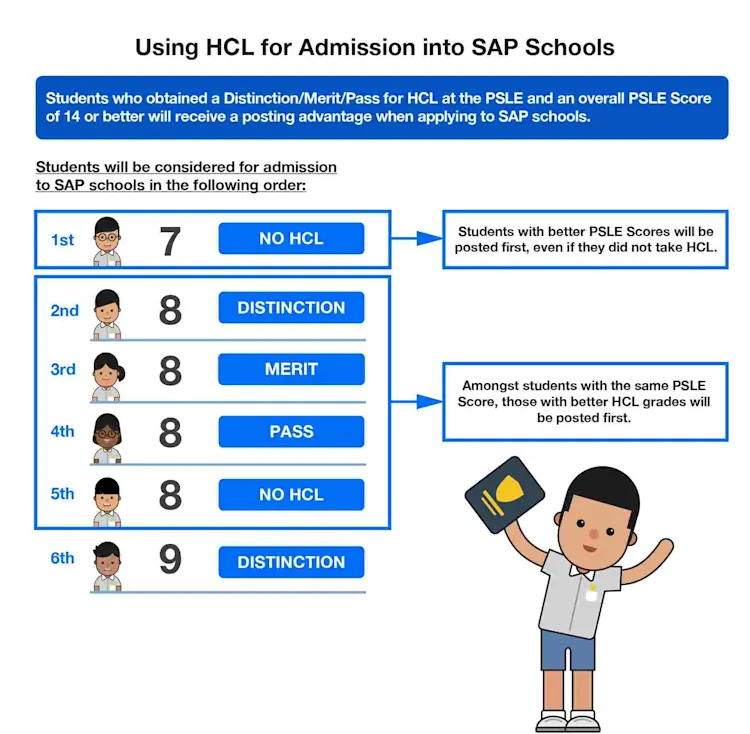
Higher Chinese (HCL) is key to Singapore’s bilingual education, enhancing language proficiency, cultural understanding, and analytical skills. It offers academic benefits, SAP school admission advantages, and broader career opportunities for students pursuing bilingual pathways Many parents assume that Higher Chinese (HCL) starts in Primary 5, but some schools introduce it as early as Primary 3. This means that students in P3–P4 who show strong interest and aptitude in the language can start developing their Higher Chinese skills earlier.
Understanding the benefits and challenges of Higher Chinese
✔ Pros:
Stronger language foundation, which benefits students in secondary school and beyond.
Bonus points for SAP (Special Assistance Plan) schools, providing an advantage in secondary school admissions.
More exposure to advanced vocabulary and writing techniques, which improves overall Chinese proficiency.
❌ Cons:
Heavier workload with more complex texts and writing requirements.
Requires strong time management to balance with other subjects.
May not be necessary unless a student plans to use Chinese extensively in the future.
When Should Students Start Higher Chinese?
Primary 3–4 (P3–P4):
Recommended for students who show strong interest and ability in Chinese.
Helps them build foundational skills gradually before Upper Primary.
Primary 5–6 (P5–P6):
Students not in HCL earlier can still opt in during P5.
Offers an advantage for secondary school admissions, especially for SAP schools.
🔎 Key Considerations for Parents
Assess Readiness – Does your child enjoy learning Chinese, and do they have a good grasp of vocabulary and writing?
Monitor Progress – Can your child handle the extra workload without affecting performance in other subjects?
Long-Term Goals – If planning for SAP secondary schools, starting HCL early gives students a stronger advantage.
Discover the full benefits of Higher Chinese and how it shapes your child's education journey here.
LingoAce: A Head Start in Higher Chinese from Primary 1
With Singapore’s refreshed mother tongue curriculum introducing interactive learning tools, early Chinese exposure is more engaging than ever. LingoAce integrates Higher Chinese from Primary 1, ensuring a structured and stress-free progression into advanced learning.
📌 Why LingoAce for Higher Chinese?
Seamless Transition – No sudden difficulty spikes in P3 or P5.
Stronger PSLE Readiness – Builds confidence in composition, comprehension, and oral fluency.
Balanced & Engaging Curriculum – Reinforces both standard and Higher Chinese effectively.
📖 Give your child an early advantage in Higher Chinese!
🔗 Join LingoAce Today For A Free Trial!
7. Upper Primary (P5–P6): Exam-Focused Preparation
As students’ progress to Primary 5 and 6, they enter the final phase of preparation for the PSLE Chinese exam. This stage focuses on exam techniques, time management, and maximizing scoring potential. With structured practice and proven strategies, students can develop the confidence needed to excel in PSLE Chinese.

PSLE Chinese Paper 1 (写作)
Scenario-Based Essay (命题作文) Students are given a theme or title and must create their own narrative based on the topic. A single prompt is provided to guide the storyline, but students are expected to develop their own ideas.
Picture Essay (看图作文) Students are shown 6 sequential images that depict an unfolding story. The first five images illustrate the beginning and development of an incident, while the final image is a question mark (?), prompting students to create a logical and well-structured conclusion to complete the story. To understand the pros and cons of these 2 essay formats, explore the key differences between these 2 approaches in our blog here.


🔗 Find out More! Overcoming Challenges in PSLE Chinese Composition Writing
Challenge 1: Awkward phrasing
Many students struggle with organizing ideas, using descriptive language, and managing time effectively when writing compositions. A common challenge is thinking in English and translating into Chinese, which often leads to awkward phrasing and loss of meaning, resulting in poorly structured essays. Additionally, within the exam’s time constraints, students must balance planning, writing, and reviewing, making it difficult to produce high-quality compositions.
Solution 1: Understand the Picture content thoroughly
To write effectively, students should adopt the 四要素法 (Four Key Elements) when describing a picture:
✅ 所见 (What You See) – Describe the people, objects, and surroundings in the image clearly.
✅ 所闻 (What You Hear) – Include sounds or conversations that may be happening in the scene.
✅ 所感 (What You Feel) – Express emotions and reactions towards the situation.
✅ 所思 (What You Think) – Share personal thoughts and reflections on the event.
By integrating these elements, students can create a more vivid and immersive composition, enhancing both content and storytelling.

Challenge 2: Unable to Adapt to Different Composition Topics
Many students struggle with adapting their stories to different prompts and lack flexibility in applying writing techniques. Some may also memorise entire compositions, which can be risky if the exam topic differs from what they prepared for.
Solution 2: Structuring The Essay with Logic
To adapt to different questions, students should:
Identify key words and direction from the provided prompt (找出关键词和写作方向).
Think about the story’s logical conclusion before writing (思考故事结尾的道理).
Ensure the first paragraph is well-structured, as it cannot be changed (必须抄写第一段,不能更改)
Keep the storyline within a single day’s event to maintain clarity (故事必须在一天内结束)
Challenges 3: Time Management & Answering Techniques
Under exam pressure, many students find it difficult to allocate time effectively, often spending too much time on one section and rushing the rest. As a result, their compositions may lack structure, clarity, and depth.
Solution 3: Effective Exam Strategies To manage time effectively, students should:
⏳ Spend 5–10 minutes planning before writing to outline their ideas.
✍ Maintain clarity and coherence, ensuring ideas flow logically.
🔍 Allocate time for revision, checking grammar, sentence structure, and logical sequencing.
Help your child boost their Chinese composition skills with our PSLE Compo Booklet, specially designed for ages 9–12! Packed with powerful phrases and model sentences, this resource supports stronger writing and higher PSLE scores — with 86% of our students achieving AL4 or better. Redeem Yours Now!
By integrating structured planning, effective storytelling techniques, and strategic time management, students can write with confidence and significantly improve their PSLE Chinese composition scores.
PSLE Chinese Paper 2 (语文理解与应用) Format
The PSLE Chinese Paper 2 consists of two sections—Section A (Multiple-Choice Questions) and Section B (Open-Ended Questions)—designed to assess students’ comprehension and language application skills. The paper carries 90 marks and has a duration of 1 hour 40 minutes.

📌 Section A: Multiple-Choice Questions (50 Marks)
This section evaluates students' ability to apply language knowledge and understand passages through MCQs. It includes:
Language Application (语文应用) – Tests vocabulary and grammar usage.
Cloze Passage (短文填空) – Requires students to fill in blanks using context.
Comprehension MCQs (阅读理解) – Assesses understanding of two passages through inference and contextual clues.
📌 Section B: Open-Ended Questions (40 Marks)
This section requires students to formulate their own answers, demonstrating deeper comprehension skills. It includes:
Dialogue Completion (完成对话) – Tests grammar and contextual language use.
Comprehension Open-Ended (阅读理解二) – Requires students to extract and interpret information from a passage.
Overcoming Challenges in PSLE Chinese Comprehension (语文理解与应用)

Challenge 1: Lack of Familiarity with Comprehension Question Types
When it comes to PSLE Chinese paper 2, many students struggle with answering comprehension questions due to their lack of familiarity with different question types. They may misinterpret the questions, provide incomplete responses, or fail to use the correct answering format, resulting in unnecessary mark deductions.
Solution 1: Mastering Comprehension Question Types
To tackle comprehension effectively, students must recognize the different question formats and apply the appropriate answering techniques.
✅ Response-Based Questions (反应题) – Identify changes in a character’s actions (动作), words (语言), expressions (表情), and emotions (感受) before and after an event.
✅ Comparison Questions (比较题) – Compare either two individuals' attitudes towards the same situation (A vs. B) or one individual’s perspective before and after an event (前 vs. 后).
✅ Contextual Vocabulary Questions (语境词汇理解) – Understand how specific words contribute to the meaning and tone of the passage.
By practicing these structured answering techniques in workshop-based training, students can develop confidence and accuracy in comprehension questions.

Challenge 2: Low Stamina for Full-Length Comprehension Passages
Many students lose focus when reading long passages, leading to careless mistakes and incomplete answers. With the lack of focus, students often struggle to extract key details and analyze implied meanings effectively.
Solution 2: Strengthening Reading Stamina with Full Passage Practice
✅ Break down passages into sections – Identify the main idea of each part before attempting the questions.
✅ Summarize key points – Highlight important details and paraphrase information to improve understanding.
✅ Practice answering full-length comprehension passages to build endurance and improve focus. Regular full-passage training helps students process information efficiently and complete comprehension exercises with confidence.
Challenge 3: Poor Time Management Leading to Unfinished Answers
Some students spend too much time on certain questions, leaving others incomplete. This results in unnecessary mark loss, even when they understand the passage.

Solution 3: Timed Practice and Strategic Answering Techniques
✅ Allocate time wisely – Spend 1–2 minutes skimming the passage before answering questions.
✅ Attempt easier questions first – Secure marks quickly by answering straightforward questions before tackling the more challenging ones.
✅ Use mock papers – Practicing under timed conditions improves time management skills and helps students complete all comprehension questions within the exam duration.
By developing efficient answering techniques and practicing under exam conditions, students can effectively manage their time and maximize their PSLE Chinese scores.
PSLE Chinese Paper 3 (口试 & 听力)
PSLE Chinese Paper 3 evaluates students’ ability to speak fluently, articulate thoughts clearly, and comprehend spoken Chinese effectively. This paper consists of two sections: Oral Communication (50 marks) and Listening Comprehension (20 marks).

1. Oral Communication (50 marks) 口试
The Oral Exam comprises two components:
Passage Reading (朗读短文) – Students are assessed on pronunciation, fluency, and articulation while reading a given passage.
Video Conversation (看录像说话) – Students watch a one-minute video and discuss the topic, demonstrating clear expression, critical thinking, and structured responses.
💡 Key Assessment Criteria:
✔ Pronunciation & fluency
✔ Grammatical accuracy
✔ Logical sentence structure
✔ Coherent and well-developed responses
2. Listening Comprehension (20 marks) 听力
The listening comprehension section tests students’ ability to process and analyze spoken Chinese. Questions are designed to assess:
Factual Understanding – Identifying specific details from an audio passage.
Summary Skills – Extracting the main ideas and key points.
Inferential Reasoning – Understanding implied meanings and making logical conclusions.
Many students often overlook the importance of PSLE Chinese Paper 3, assuming it is an easy section to score well in. However, during the actual exam, they may struggle to express themselves fluently, analyze video content critically, and identify key information in listening comprehension. The lack of practice and complacency can result in undesirable scores.
Overcoming Challenges in PSLE Chinese Oral and Listening (口语与听力)

Struggling with Chinese Oral? You're Not Alone. Many students face challenges during oral exams — from not knowing how to start a conversation, to struggling with vocabulary and current affairs. At LingoAce, we tackle these common pain points head-on with targeted oral practices designed to build confidence, fluency, and real exam readiness.
Challenge 1: Struggling to Start and Continue a Conversation
Some students find it difficult to initiate and sustain a conversation, leading to short, hesitant responses. This affects their fluency and confidence.
Solution 1: Mastering the 5所 Method
Students should practice using the 5所 method (五所: 所见, 所闻, 所感, 所思, 所做) to structure their responses logically.

所见 (What You See) – Describe the people, locations, time, and actions in the video.
所闻 (What You Hear) – Identify key dialogue or sounds that provide context.
所思 (What You Think) – Share your personal opinions and reasoning about the situation.
所感 (What You Feel) – Express your emotions based on the video content.
所行 (What You Would Do) – Conclude with a reflection on what actions you would take in a similar scenario.
总结 (Conclusion) – End with the key lesson learned from the video.
Challenge 2: Lack of Thematic Vocabulary for Discussion
Students often struggle to provide detailed answers due to limited vocabulary. Without knowledge of key phrases related to common PSLE topics, responses may sound generic and lack depth.
Solution 2: Strengthening Vocabulary with Thematic Resources
To build a strong vocabulary foundation, students should use Chinese oral infographics, revision booklets, and thematic word lists from oral worksheets. Familiarity with common PSLE themes (e.g., environment, technology, social issues) allows students to form well-rounded responses.
🔗Claim Yours Now! Challenge 3: Lack of Awareness of Current Affairs
A major component of the oral discussion involves expressing opinions on real-world topics. Students who are unaware of current events may struggle to provide relevant insights.
Solution 3: Staying Informed on Key Topics
LingoAce’s curriculum ensures students stay updated on important issues by incorporating discussions on current affairs relevant to PSLE themes. Regular exposure to news articles, oral worksheets, and classroom discussions enhances students’ ability to form informed opinions.
PSLE Goal Setting: A Strategic Approach To Success
Achieving success in the PSLE Chinese Exam requires strategic preparation across different components. Understanding the weightage of each section and focusing on key skills can make a significant difference in performance.

PSLE Score Weightage: How to Prioritise
To achieve high distinction (AL1-AL4) in PSLE Chinese, students must perform well across different sections. The estimated weightage of each component is as follows:
Paper 1: 作文 Composition (20%)
Paper 2: 阅读理解 + 字词 Comprehension & Vocabulary (22% + 23%)
Paper 3: 口试 Oral (25%)
Paper 3: 听力 Listening (10%)
Since oral and listening comprehension make up 35% of the total score, these sections should not be underestimated. Many students focus solely on writing and comprehension but struggle in oral due to lack of practice.
Case Study: Personalised Improvement Plan for PSLE Chinese
In preparing for the PSLE Chinese exam, it is essential to assess a student’s strengths and weaknesses across different components. Let’s take a look at a Primary 6 learner who currently has an AL5 in their PSLE Chinese mock test.
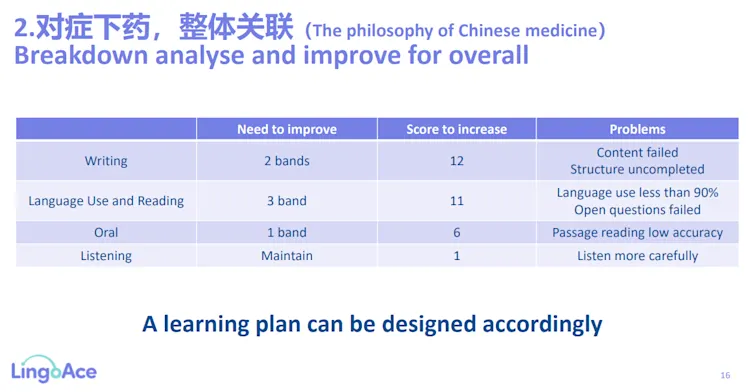
From the analysis:
✔ The student is strong in Listening Comprehension with a high score.
❌ Writing, Language Use & Reading, and Oral Communication need improvement to achieve a better overall score.
Component | Improvement Needed | Score to increase | Problem Identified |
Paper 1 (作文 Composition) | 2 bands | +12 | Content weak, structure incomplete |
Paper 2 (阅读理解 + 字词Comprehension) | 3 bands | +11 | Below 90% accuracy, open-ended struggles |
Paper 3 (口试 Oral) | 1 band | +6 | L ow accuracy in passage reading |
Paper 3 (听力 Listening) | Maintain | +1 | Needs more careful listening |
Using a structured learning plan, we can break down the weak areas, analyze the gaps, and implement targeted strategies to improve from a AL5 to AL3 band.
Key Factors for Scoring Well in PSLE Chinese
✅ Strong Storytelling Ability in Composition – Good ideas, vivid descriptions, and logical flow.
✅ Effective Language Use – Mastery of 1900 MOE vocabulary words.
✅ Confident Oral Responses – The ability to elaborate and justify opinions.
✅ Listening Accuracy – Identifying key information under time constraints.
📝 Mock Exams and Past-Year Paper Practices
To help students gain confidence and exam readiness, we are now offering structured mock exams and regular timed practices using past-year PSLE papers. These sessions are designed to familiarise students with the actual exam format, build time management skills, and provide targeted insights into their strengths and areas for improvement.
As part of this effort, LingoAce is offering Chinese Mock Test for P3–P5 students at our 111 Somerset centre. The mock test includes:
A full Chinese Mock test based on the MOE syllabus
1-on-1 post-test review with detailed question analysis
A comprehensive performance report with strengths and weaknesses breakdown
📍 Limited offer: The first 10 sign-ups monthly will enjoy complimentary access. 🔗 Sign Up Now
PSLE Chinese 2025 Examination Calendar
To keep you informed of the important dates especially for the 2025 PSLE Chinese exam, we have broken down the Singapore Examinations and Assessment Board (SEAB) Chinese exam timetable just for you!
Date | Examination | Type | Weightage |
13 - 14 August 2025 (Wednesday - Thursday) | Chinese Oral (口试) | Chinese | 25% |
16 September 2025 (Tuesday) | Listening Comprehension (听力) | Chinese | 10% |
30 September 2025 (Monday) 25 September 2025 (Thursday) to 26 September 2025 (Friday) 29 September 2025 (Monday) to 01 October 2025 (Wednesday) | Chinese Paper 1 & 2 (写作 & 语文应用与阅读理解) | Chinese | 65% |
1 October 2025 (Wednesday) | Higher Chinese Paper 1 & 2 | Higher Chinese | 100% |
13 - 15 October 2025 (Monday - Wednesday) | - | PSLE Marking Day | - |
November 2025 (to be confirmed) | - | PSLE Results Day | - |

For our avid blog readers, simply visit our page, sign up for a free trial and receive additional 2 free lessons after purchasing a package with us! Find Out More!
Frequently Asked Questions (PSLE Chinese 2025)
1. What is the format of the PSLE Chinese exam?
The PSLE Chinese exam consists of:
Paper 1 (Composition 写作) – 20%
Paper 2 (Language Use & Comprehension 语文理解与应用) – 45%
Paper 3 (Oral & Listening 口试与听力) – 35%
2. How is the PSLE Chinese exam scored?
Scores are converted into Achievement Levels (ALs) ranging from AL1 (highest) to AL8 (lowest). Each component contributes to the final AL score, with oral and listening accounting for a combined 35%.
3. When should my child start preparing for PSLE Chinese?
Ideally from Preschool (N2–K2) for language exposure, and more structured preparation should begin in Lower Primary (P1–P2). Mastery of vocabulary, writing, and oral fluency becomes critical by Upper Primary (P5–P6).
4. How is Higher Chinese different from standard Chinese?
Higher Chinese (HCL) is more advanced, focusing on deeper comprehension, richer vocabulary, and analytical writing. It offers bonus points for SAP school admission and broader bilingual development.
5. How important are PSLE Oral and Listening components?
Very important. Together, they account for 35% of the total score. Many students neglect these areas, but strong performance here can significantly boost the overall AL.
6. Where can I get PSLE Chinese practice materials or mock tests?
LingoAce offers free downloadable guides and mock test sessions at our 111 Somerset centre, complete with a detailed assessment report and post-test review.
For more information on our LingoAce programmes and the latest promotions, contact us for a free trial class now! We offer a variety of programs and services to help students of all levels to improve their Chinese language skills.